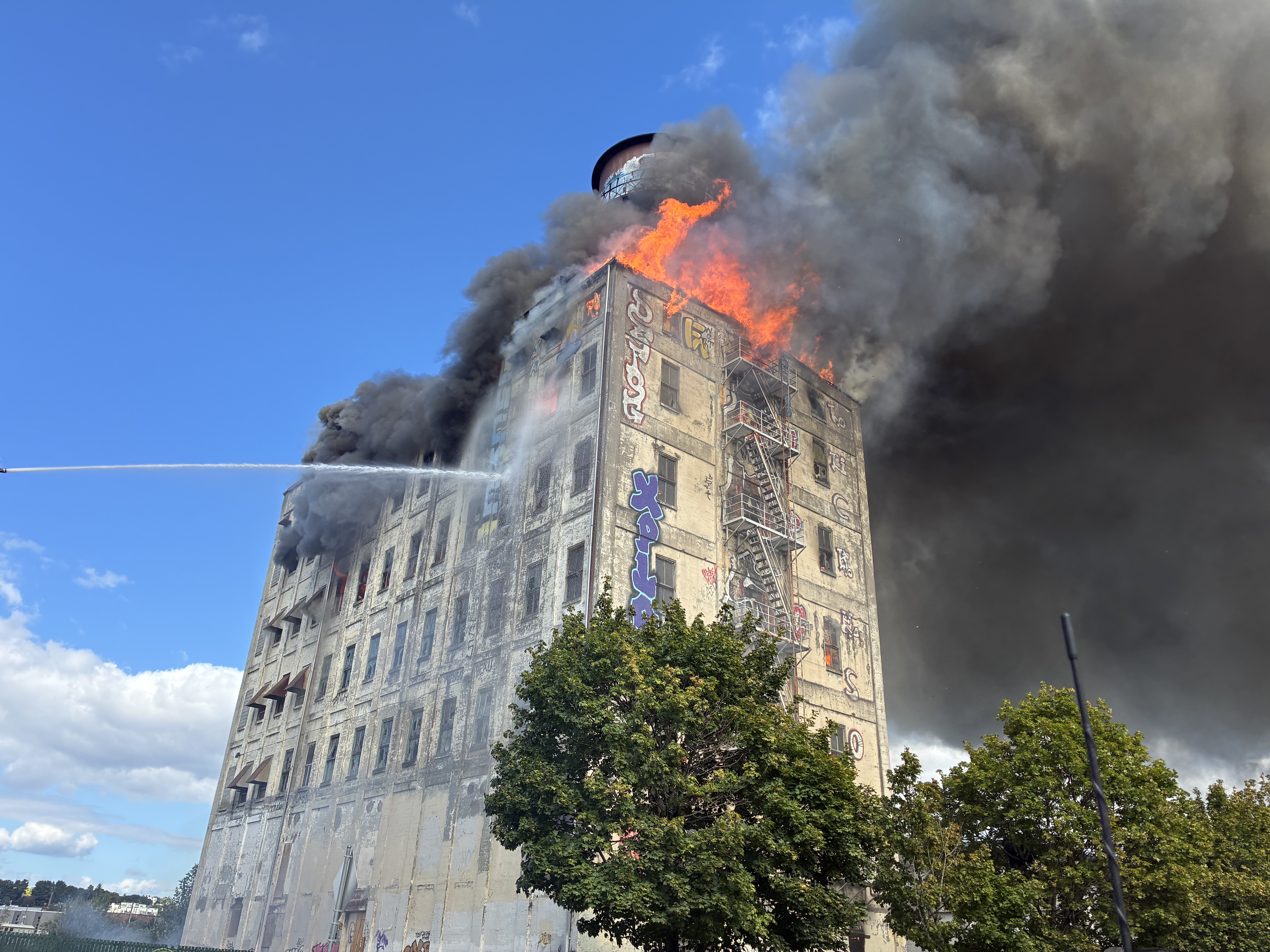
PF&R Responds To Commercial Fire At Former Columbia Mills Facility (Photo) - 08/03/26
PF&R responds to commercial fire at former Cenntenial Mills Facility
At 3:50 PM Portland Fire & Rescue responded to a commercial fire in the 1300 Block of NW Naito Parkway in the Pearl District. The incident rose to 4th alarm assignment placing nearly 100 members of PF&R on scene addressing the emergency. Nearly 2 hours after the incident was considered under control with many companies released to their home stations.
This 116-year-old 8-story former warehouse with a large water tower resting on the roof has been the site of previous responses with small fires in the thick timber flooring. Unlike previous responses with light smoke wisping out of a lower floor window, this response had heavy black and brown smoke pushing out under pressure from all sides of the structure. With this labeled as an unsafe building indicating interior firefighting is not permitted due to the danger presented by known holes in the flooring along with damaged and removed stairways, all firefighting actions are to be from the exterior using defensive fire attack tactics. The first arriving chief officer quickly requested a second alarm assignment placing just over 50 members on scene. The command officer quickly divided the building into small manageable divisions and placed a different officer in command of each to address what is labeled as the Alpha, Bravo, Charlie, and Delta Division, one for each side of the building. Fireboat 21 responded to assist in providing water if needed from the Willamette River and pump up to a truck or engine for use in the extinguishing process. Engines placed themselves on fire hydrants to pump significant amounts of water to the trucks positioned to use their elevated master streams to surround and drown the fire from a safe distance.
Unlike previous responses to this address, the fire extended vertically with heavy fire present throughout each floor with flames visible in nearly every window when looking from the North. With multiple reports of leaning walls, the heavy steel water tower structure on the roof, and concerns of structural collapse the command officer directed the members on scene to back away out of the collapse zone which is 1 ½ times the height of the building to ensure that all apparatus and members are out of harm’s way should the building fail. This significant amount of fire led to the collapse of each floor of the thick timber flooring placing much available fuel now in the bottom of the large masonry building that was now just funneling the flames and smoke upward like a large chimney. Roof failure occurred at one point just below the water tower with flames and smoke blasting out the top completely encapsulated the water tower structure for a short time.
The flames were actively pushing fire brands and large embers floating into the sky and dropping down on the roofs of neighboring buildings, into nearby trees, and onto many patches of dry vegetation starting many spot fires throughout the area. Two brush units (2-person fire apparatus with a smaller tank and complement of hose) were requested to the scene and were labeled Wildland Division adding another division to the incident. The Wildland division and crews with available hose lines were actively addressing these smaller fires and working to ensure none of the flames extended into any neighboring structures.
The command officer began to reduce the number of companies and apparatus at the incident scene about 90 minutes into the effort with all water from the master streams stopped at nearly the 2-hour mark with most of the flames extinguished. Except for a single master stream option that requires an engine and a truck to remain on scene, all other rigs picked up their hose lines and returned to their home stations.
There are hot spots that will continue to flare up overnight producing smoke and flames with crews operating in a fire watch crew on scene will address these as they arise. PF&R will operate this fire watch through the night and into tomorrow as needed.
The Scappoose Fire District Aviation Team will fly their unmanned aircraft throughout the building tomorrow to map the entire structure assisting the Portland Fire Investigations Unit in hopes of determining cause. The 3D mapping will also be provided to the City Building Engineer to help in determining the integrity of the structure and aiding in determining decisions for the future of the former warehouse. NW Naito will remain closed until determined safe due to the potential of structural collapse. The 3D mapping and a possible site inspection by the City Engineer will further determine the future of the structure and the length of any street closure.
Portland Fire would like to thank PPB for their assistance in crowd control and blocking the roadway for the safety of the community and firefighters on scene. Additional thanks to the dispatchers at BOEC for helping us in the long, drawn-out incident. Lastly, thanks to the Portland Water Bureau for directing more water to the portion of the grid used in the suppression efforts.
###
Update:
Portland Fire Investigations Unit is working with CHAIS, an non-profit K9 detection team that are trained to identify human remains. The K9 Team has performed their first sweep of the incident and did not come up with a positive hit. The team will perform another sweep of the incident area in 48-72 hours for more definitive information about the possibilities of human remains on the interior of the structure.
Portland Fire will remain the custodian of the property until the foresic investigation of the location is completed and will then transfer custody to the appropriate bureau. If the City Engineer determines the building poses a signficant risk of collapse and must come down prior to the completion of the investigation, PF&R will work with PP&D and other city bureaus involved to continue the investigation while active demolition occurs.
PBOT and PF&R want to remind the community that this is a potentially extremely dangerous situation with the large water tower complex resting on the walls at the top of this building. NW Naito is closed from NW 9th to NW 15th. Local access will be provided to residents to access their homes in the area but all pedestrian, bike, and vehicular traffic must use the established detour. Please follow signs to remain out of the collapse zone. This may be an add time to your commute or activity so please plan accordingly. Visit PBOT for more specific information about planned and efficient detours.
###