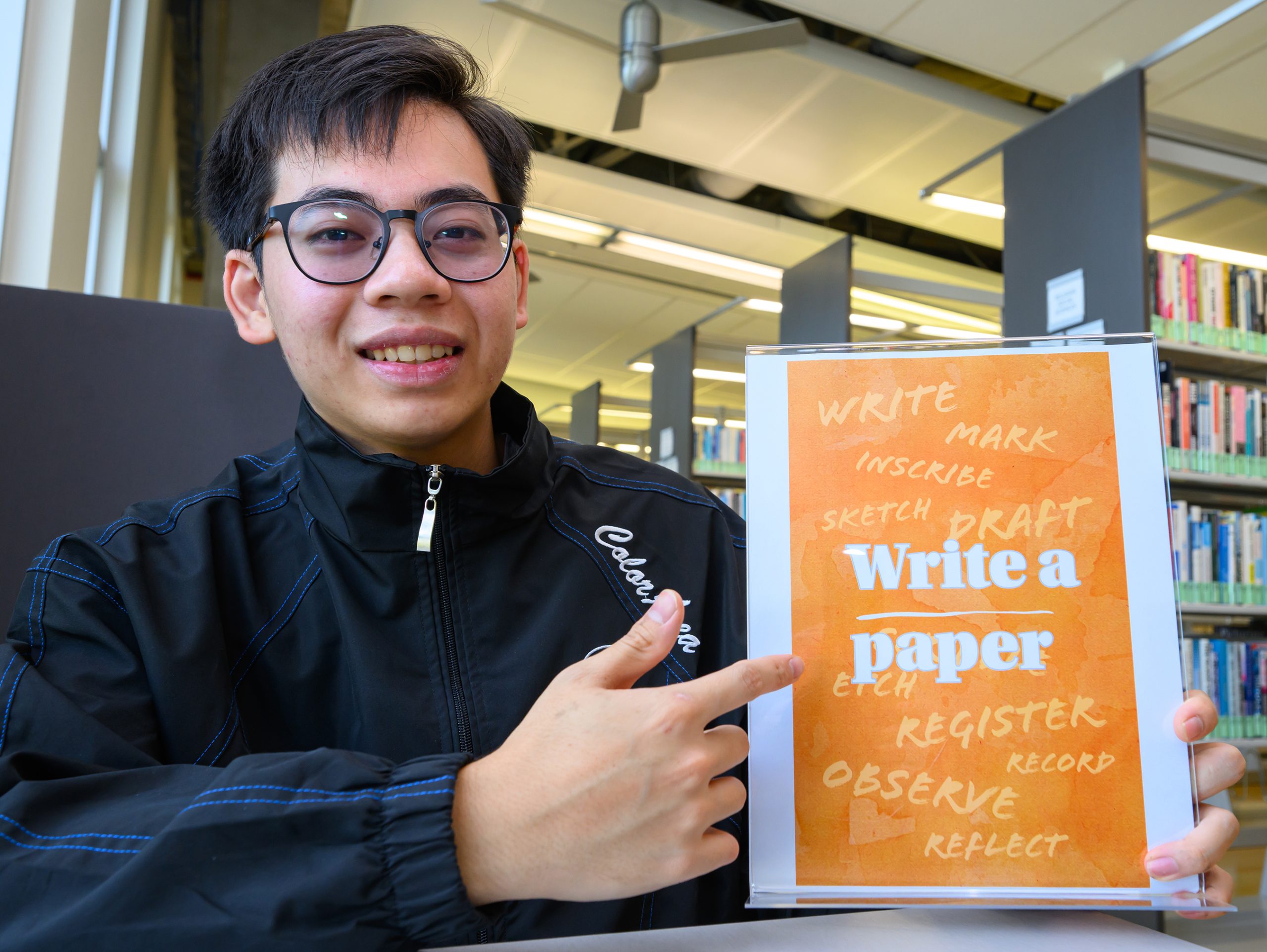
Nguyen Bui Grew Up Tending His Family’s Fields In Vietnam. Now, He’s Exploring The Potential Of AI In Medicine. (Photo) - 11/17/26
SOUTHEAST PORTLAND, Ore. – Portland Community College international student Nguyen Bui grew up helping his parents tend coffee, pepper and fruit crops. Today, the computer science student is contributing to international research that could help computers better analyze microscope images used in cancer research.
Bui is an equal contributor and co-author of a research paper examining a challenging problem in medical imaging: helping computers more accurately identify different structures in tissue samples.
The paper, “CoDiR: Confidence-Guided Diffusion Refinement for Semi-Supervised Histopathology Segmentation,” was accepted to the 2026 MICCAI COMPAYL Workshop in Strasbourg, France. Bui is listed with PCC as his institutional affiliation, putting the college's name alongside those of researchers from other institutions involved in the project.
"Having an undergraduate student publish research at an international conference while completing lower-division coursework is an outstanding achievement," said PCC Program Dean of Computing and Engineering Gayathri (GD) Iyer. "It highlights the incredible potential of our students and demonstrates that the foundational education provided at PCC, along with the students' motivation, enables them to engage with high-level academic research."
She added, "Having additional avenues, such as research opportunities, hands-on projects, and practical applications of emerging technologies, allows students to explore their interests early and push their limits."
For Bui, who lives in Southeast Portland, the opportunity combines a longtime love of mathematics with his desire to create something useful.
“I’ve had a passion for mathematics since I was young, along with a natural curiosity and love for creating things,” he said. “I chose computer science because I wanted to build something meaningful with that foundation.”
Researchers developed Confidence-Guided Diffusion Refinement (CoDiR), an AI method that outlines structures in microscope tissue images. By spending extra effort double-checking uncertain areas, CoDiR matches or outperforms leading techniques despite limited training data. While still experimental, this research could eventually help health professionals analyze tissue more accurately for disease.
“I wanted to challenge myself in a research environment and see what I could contribute, especially by applying AI to health care, a field where I feel this technology can make a real difference,” Bui said.
Long before Bui worked with computer code or medical images, he learned about persistence from his parents. His family grows coffee, pepper, durian, passion fruit and other crops, and Bui often helped with the work while growing up.
“They taught me the value of hard work and dedication simply by living it every day,” he said. “As a child, I was often ‘recruited,’ in a fun way, to work alongside them, and through that I came to understand just how demanding that work truly is.”
Pursuing an education abroad required his family to make its own investment in his future. Bui describes it as “placing a bet,” supported by the crops his parents worked so hard to produce.
“Knowing that, I couldn’t afford to back down,” he said. “My parents have always been my driving force, pushing me to move forward every single day.”
That drive has taken Bui from working beside his parents in agricultural fields to contributing to research at the intersection of computer science and medicine. For him, the connection is straightforward: Use what he has learned to solve difficult problems and make his family’s investment count.
“The math and computer science groundwork I built through my coursework at PCC’s Southeast Campus gave me the confidence and skills to take on this kind of research,” he said.
For more information, visit the PCC Computer Science Program, or read his research paper profile.
About Portland Community College: Founded in 1961, Portland Community College is the largest post-secondary institution in Oregon and provides training, degree and certificate completion, and lifelong learning to more than 57,000 full- and part-time students in Multnomah, Washington, Yamhill, Clackamas, and Columbia counties. PCC has four comprehensive campuses, 10 education centers or areas served, and approximately 200 community locations in the Portland metropolitan area. The PCC district encompasses a 1,500-square-mile area in northwest Oregon and offers two-year degrees, one-year certificate programs, short-term training, alternative education, pre-college courses and life-long learning.
Visit PCC news on the web at http://news.pcc.edu/
For B-ROLL footage, visit PCC campus and student life highlight reel.