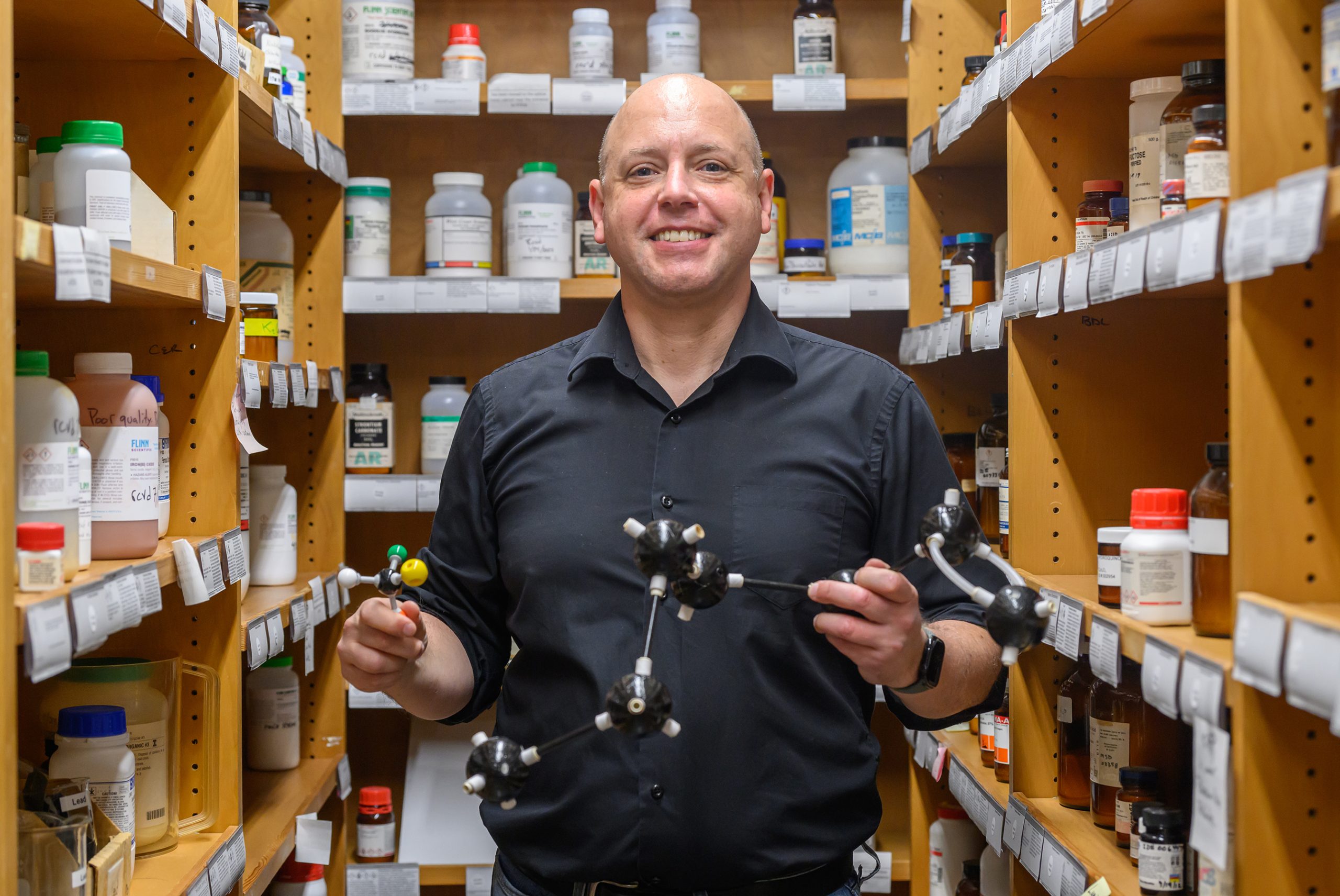
Organic Chemistry Students Achieve Breakthrough In Three-component Distillation Research (Photo) - 09/29/26
GRESHAM, Ore. – Four Portland Community College students – two from the Gresham area – have had the rare opportunity to work in lab research, something often restricted to university upperclass or graduate students.
Miguel Gomez of Gresham, Kana Heitzman of Southwest Portland, Alondra Ramirez-Sierra of Canby and Ruth Pablo Juan of Beaverton spent much of the year working with PCC instructor Ted Picciotto. They contributed to the field of organic chemistry by advancing the way science is done with a unique three-component distillation experiment that may help students in future research for fields such as alcoholic beverage production with hands-on real-world application.
Beginning this spring, the organic chemistry students at PCC’s Sylvania Campus set out to create the unique experiment. PCC Chemistry Department Chair Picciotto, who worked in the wine industry prior to joining the college 17 years ago, said he “simply couldn’t find” such an experiment in the chemical education literature.
“Students are the experts in their own experiences, and their feedback can reveal barriers that may not be obvious to educators,” Picciotto said. “I enjoy finding ways to make chemistry accessible to students who may not initially see themselves as ‘chemistry people."
According to Picciotto, fractional distillation separates liquids based on how quickly they boil. Most college lab experiments the team studied used mixtures of only two liquids. Adding a third liquid makes the experiment harder. The chemicals must not react with each other, they need to boil at different temperatures, and they must be safe for students to use in a college lab.
The team included ethanol to make the experiment similar to a process used in a distillery. They also chose chemicals with different molecular shapes. This allowed students to use a tool called Fourier-transform infrared spectroscopy (FTIR) to identify each chemical and tell the substances apart in a mixture.
Miguel Gomez attended David Douglas High School and hopes to become an engineer who develops green technology. He joined the project after it had started and helped improve the experiment.
The team used a small, 25-milliliter flask to study how temperature, different chemicals and materials inside the distillation column affected the results. They used a testing method called gas chromatography-mass spectrometry (GC-MS) to measure what was in each sample.
Getting the liquids to separate well was the team’s biggest challenge. In early tests, the samples contained only about 40% to 60% ethanol mixed with another chemical. The students used artificial intelligence to brainstorm ways to improve the distillation column. One idea was to add stainless steel wire mesh inside the column. The mesh gave the liquid and vapor more surface area to interact. After adding more mesh, the team was able to produce samples that were nearly 90% ethanol, with only small amounts of the other chemicals.
“The most exciting part is that this is not simply a laboratory exercise with a predetermined answer,” Picciotto said, sharing that it has been evolving but highly successful due to the team's persistence.
For Gomez, the project connected small-scale laboratory work to industrial chemical processes, including crude oil separation. His interest in chemical engineering began after a high school biology lecture about climate change’s effects on biodiversity, ocean acidification and human health. It grew during a 2023-24 laboratory internship at Oregon Health & Science University, where he participated in environmental research and analytical electrochemistry.
Gomez plans to transfer to OSU in fall of 2027 to study chemical engineering. He has completed a chemical engineering sequence through Oregon State Ecampus and said that experience, along with advice from other engineering students, has prepared him for upper-division coursework.
“I think the transition from a community college to a four-year university will be smooth,” Gomez said. “I have a clear understanding of the expectations for my upper-division courses and the remainder of my education. I am striving to become an R&D Engineer working in emerging green technologies, particularly carbon capture, green hydrogen, and solid-state batteries.”
He hopes recognition of the team’s work encourages other students to pursue research.
“PCC is the right place for anyone, regardless of background, looking to pursue a quality, affordable education,” Gomez said.
Kana Heitzman of Gresham, an environmental and civil engineering transfer student, said the open-ended research offered experience beyond a standard laboratory assignment.
“The success of this research project was an eye-opening experience,” Heitzman said. “Not only was it an opportunity to work in a more professional setting, but we had the freedom to experiment with our own ideas and use the knowledge we built from the general chemistry and organic chemistry sequences.”
“Contributing research that could improve the labs of future organic chemistry students gave me more motivation to pursue my degree,” he said. “This research project was an example of how open minds, strong foundational knowledge and teamwork can result in success.”
Heitzman plans to transfer to Portland State in fall 2027. He said he is open to possibilities but interested in environmental consulting fieldwork and infrastructure design. "Right now, I am taking as many courses as I can at PCC to take advantage of the smaller class sizes."
Heitzman agreed, adding, "PCC is an amazing school to enroll in for people in every aspect of life. Classrooms are diverse and offer many different perspectives which helps you keep an open mind while learning."
"I've also found it easy to communicate with my professors when I am struggling or have questions," said Heitzman, who went to Grant High School and has also earned a Pre-Apprenticeship & Trades Certificate.
About Portland Community College: Founded in 1961, Portland Community College is the largest post-secondary institution in Oregon and provides training, degree and certificate completion, and lifelong learning to more than 57,000 full- and part-time students in Multnomah, Washington, Yamhill, Clackamas, and Columbia counties. PCC has four comprehensive campuses, 10 education centers or areas served, and approximately 200 community locations in the Portland metropolitan area. The PCC district encompasses a 1,500-square-mile area in northwest Oregon and offers two-year degrees, one-year certificate programs, short-term training, alternative education, pre-college courses and life-long learning.
Visit PCC news on the web at http://news.pcc.edu/
For B-ROLL footage, visit PCC campus and student life highlight reel.
###