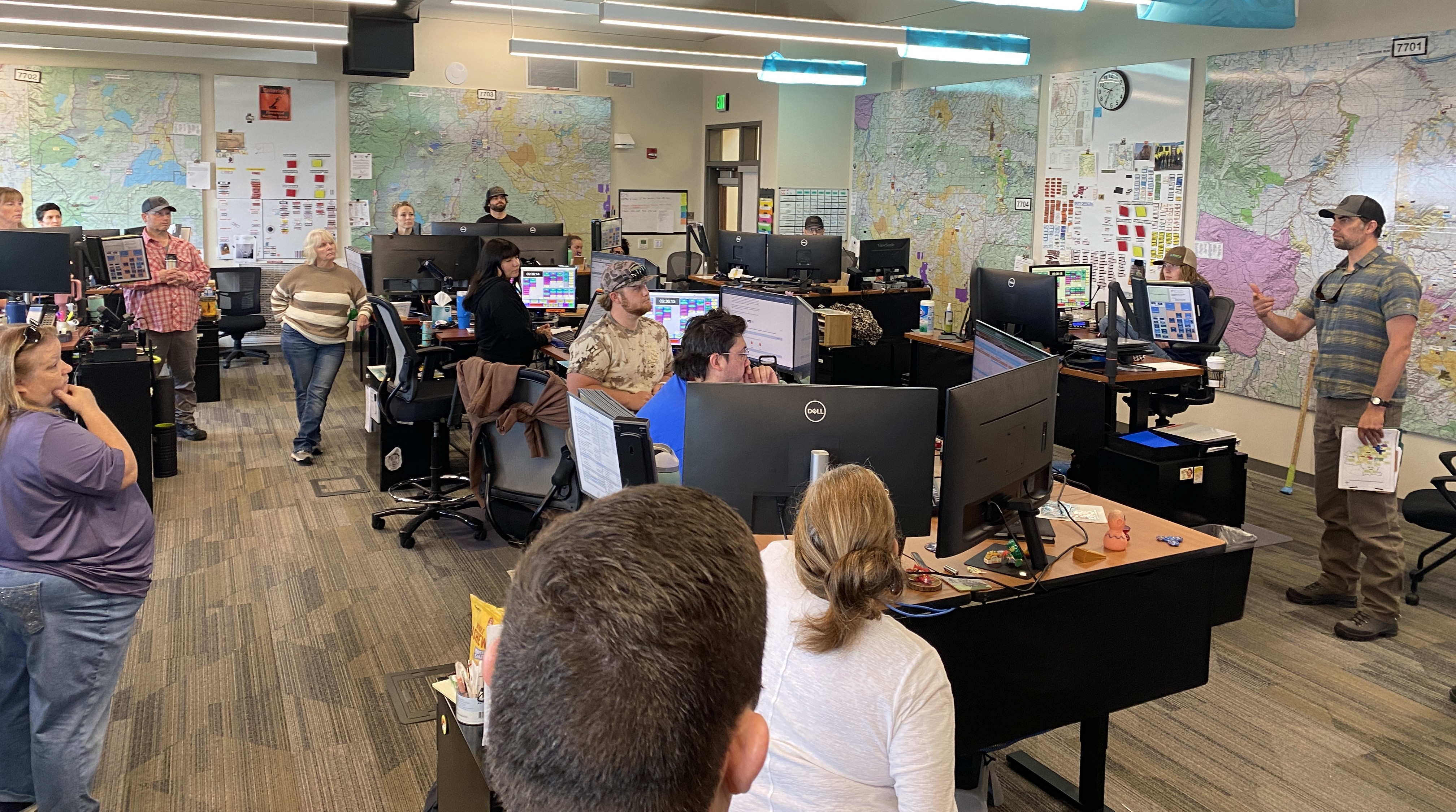
Interagency Cooperation Puts Fires Out Quickly In Central Oregon (Photo) - 08/03/26
REDMOND, Ore.—The Central Oregon Interagency Dispatch Center is working hard to catch and put out wildfires while they are small. They have the responsibility to coordinate the first response to these fires, called “initial attack.”
“The center has been key to suppressing more than 100 fires already this year with their efficient and fast deployment of initial firefighting resources,” said Rick Fletcher, Assistant District Forester for the Oregon Department of Forestry’s (ODF) Central Oregon District. The center coordinates the physical firefighting resources of ODF, U.S Forest Service and the newly created U.S. Wildland Fire Service.
“Most importantly the center brings together hundreds of years of state and federal firefighting experience to manage those resources to protect the people and property of central Oregon no matter who owns the land,” said Fletcher.
This close cooperation between state and federal agencies didn’t always happen historically.
“It was crazy 20-years ago, Forest Service trucks would pass ODF trucks on the same road going opposite directions to different fires because both agencies would only do initial attack on their lands,” said Jason Gibb, U.S. Forest Service Deputy Fire Staff for Central Oregon Fire Management Service. “Now under our jointly funded and jointly staffed center, we use the closest forces concept. The firefighting resources closest to the fire get dispatched no matter the landowner.”
According to Fletcher, there are two major advantages to this joint approach to dispatching: “We get to fires quicker and safety is improved since we are moving resources shorter distances.”
That quick response is also extremely efficient, especially during intense thunderstorm activity. For example, on July 22, the central Oregon area received an estimated 2,000 lightning strikes from a storm. Firefighters responded to more than 35 reported wildfires. Several of those fires had an interagency response, including Incident #551, that was burning three miles northeast of Terrebonne on the north side of the Crooked River east of Smith Rock State Park.
“The fire was on federal land but responding resources include municipal, state and federal engines and crews,” said Fletcher. “Because of the fast joint response, we stopped the forward progress that night. It was a great catch.” Fletcher has firsthand knowledge of that quick response since he was one of the closest resources and was the incident commander for the fire.
The center’s job doesn’t stop with a successful allocation of resources nor when the lightening stops.
“Lightening that strikes trees or vegetation can sometimes smolder for several days without producing significant smoke,” said Matt Noble, who monitors ODF smoke cameras and other detection resources for the central Oregon area. “Sometimes we see a little smoke for a few minutes then it’s gone because of the rain with the thunderstorm. That makes monitoring that area critical for the next several days in case it flares up.”
Those found fires’ locations are pushed to the center’s other staff for quick coordinated action. Then ground or air resources are sent to the fire starts to catch them before they can grow.
The center also tracks all firefighting resources in the area. The numbers change daily, and even hourly, there are a lot of fires in central Oregon. Currently, there are 32 large fires in Oregon with more than 11,700 people assigned to them, and nearly all of those fires and resources are on the east side of the state. This year, wildfires have burned more than 2 million acres statewide, with much of that in central and eastern Oregon.
“The challenge for the center is to have resources available for initial attack when these lightning storms hit, while not hampering the efforts to control the current large fires,” said Fletcher.
The center does this though a jointly agreed upon priority list, but center staff still have to use their expertise to make that final decision on what firefighting resources go to which fire when.
“It’s not necessarily first come first served during the height of fire season, said Gibbs. “We look at (fire) fuels, weather, terrain, distances to those priorities, prior thinning and treatment like prescribed fire, and more—just many factors we take into consideration before we make our dispatch decisions. And, all this must be done quickly and efficiently.”
The central Oregon area is so large—encompassing land from The Dalles down past Prineville and across to John Day—that one interagency center is not enough to coordinate all the firefighting resources to protect Oregonians, their communities, and the state’s natural resources. “We have three primary interagency centers we coordinate and staff that support central Oregon,” said Fletcher. Those centers are in Redmond, Vancouver, and John Day. Relevant and timely information is shared between the centers based on fire locations and available resources.
“I’ve worked firefighting jobs all over the state and this interagency model of centers is the most efficient and most effective,” said Fletcher. “It’s the best way to protect people and property.”
For more on the Central Oregon Interagency Dispatch Center see: Central Oregon Interagency Dispatch Center
For the latest update on central Oregon wildfire activity see: Wildfire Updates | Air Quality | Central Oregon Fire Information