Mild Winter, Warm Spring Have Led To Emerald Ash Borers Emerging Weeks Earlier Than Usual (Photo) - 05/18/26
KING CITY, Ore. – Oregon’s extremely mild winter and warm spring days have caused larvae of the invasive emerald ash borer (EAB) pest to mature faster and emerge weeks earlier than usual.
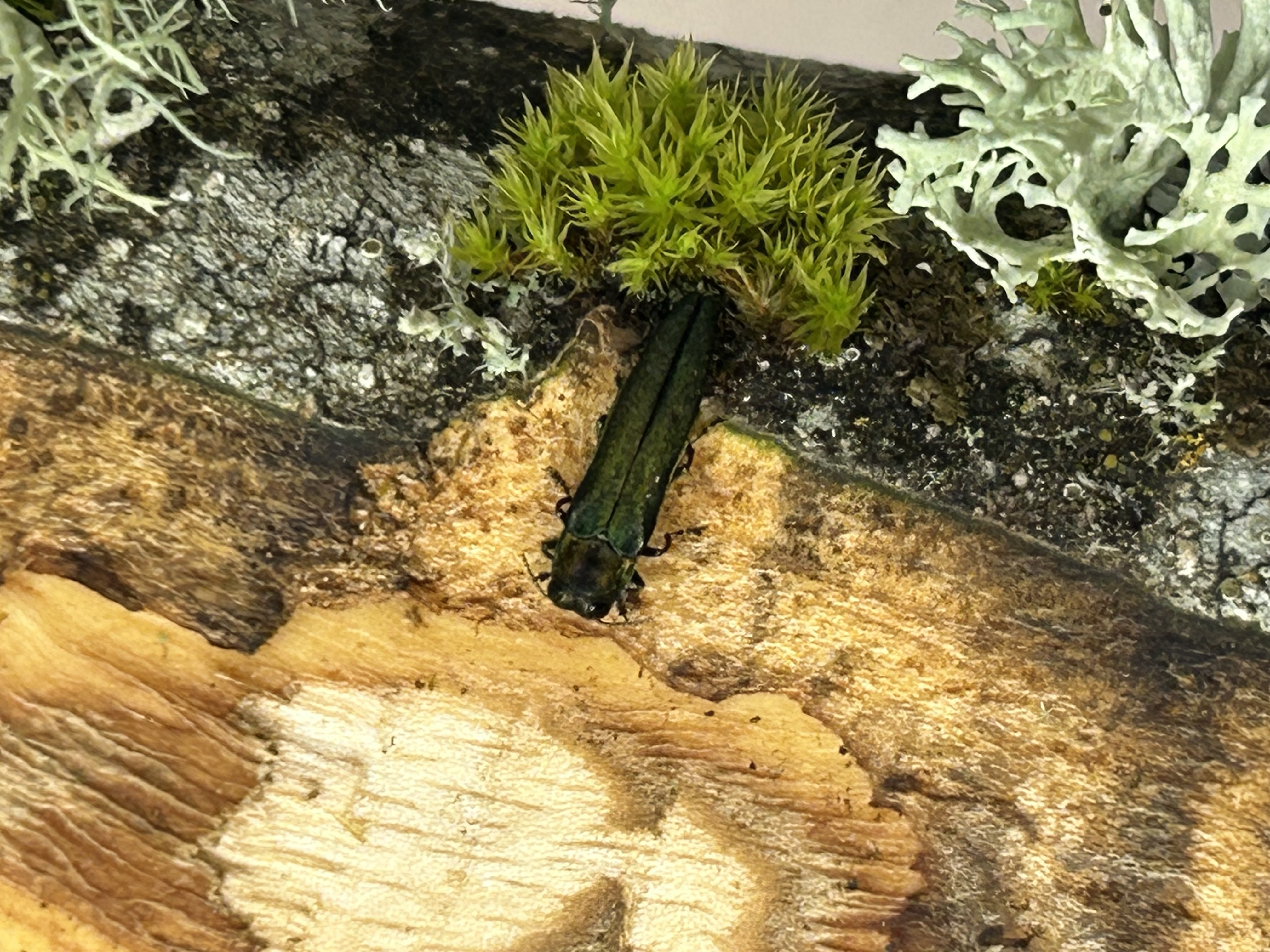
Oregon Dept. of Forestry Invasive Species Specialist Wyatt Williams has confirmed that in early May after peeling back bark from a section of a Raywood ash tree in King City in southeast Washington County he saw a fully formed emerald ash borer adult that looked ready to emerge.
In the four years since EAB was first found in Oregon in 2022, adults in northwest Oregon have always begun emerging from inside tree trunks sometime in the first two weeks of June. EAB continues maturing and emerging for several weeks into July.
“The very mild winter and the many warm spring days we’ve had in Oregon this year has allowed EAB larvae to develop more rapidly into adults,” said Williams.
He wasn’t completely surprised by finding an adult so early in May. “When we looked at the updated models that accounted for warmer than expected temperatures this spring, the models pointed toward an earlier emergence of adults. That’s exactly what we’re seeing,” he said.
King City is within the existing Washington County EAB quarantine zone. However, Williams’ discovery of the pest there was the first time it had been seen inside the city of about 5,000 people southeast of Portland.
Williams came upon the adult when he was following up on a hotline report made by Warren Tickner of Pacific Landscape Management. Tickner is contracted by the city to look after the publicly owned trees. He reported that Raywood ash trees in King City looked to be declining, a classic sign of EAB.
Williams said he found several of King City’s ash trees suffering dieback from verticillium wilt, a soilborne fungal disease. “Peeling back bark from a section of trunk of one of the trees, I found larval galleries and an EAB adult ready to take flight.”
He also found two of the ash trees had the characteristic twisting galleries made by EAB larvae under the bark. Since then an adult EAB has been seen at a new site in Woodburn, a place less than a mile from Wyffels Park where the pest was found last year.
Erin Carey is Public Information Officer for King City. She said in response to the discovery of EAB in the city, “we appreciate our residents’ patience as we navigate the proper way to address and remove any trees infested with the emerald ash borer as soon as possible. We would also like to commend our landscape contractor for taking swift action when reporting his suspicion of the EAB to the appropriate authorities.”
Williams noted that the rate of growth of EAB larvae is closely tied to outside temperatures. This past winter in western Oregon was tied with 1934 as the warmest on record, followed by record-breaking or near record-breaking high temperatures this spring.
ODF Forest Entomologist Christine Buhl said, “these changes in climate favor insect pests. It gives EAB adults more time to find a mate and then find an ash tree to infest with their eggs. At the same time, hotter temperatures and drought stress trees. This makes them less able to resist infestation and they may decline and die sooner.”
Since it can be hard to see EAB adults, ODF suggests the public learn to identify ash trees and monitor for signs of EAB infestation, such as dieback in the upper canopy. More information about identifying ash trees or emerald ash borer and what signs to look for can be found at OregonEAB.com.
If you suspect an ash or olive tree is infested, report it to the Oregon Invasive Species Council at https://oregoninvasiveshotline.org/reports/create. Or phone in a report at 1-866-INVADER (1-866-468-2337).
# # #