More Than 2 Million Seedlings Planted This Season In Oregon’s State Forests (Photo) - 03/17/26
Salem, Ore.—A mild winter with spring-like weather has helped the Oregon Department of Forestry’s (ODF) replanting of state forest timber harvest areas stay ahead of schedule this year with approximately two million seedlings already in the ground.
“This has been a great planting season with no shutdowns due to weather,” said John Walter, ODF’s State Forests Silviculturist. “All our districts are done or will be this month. The only exception being Klamath Lake—they typically plant into May and have about 60,000 to get in.”
Like most Western Oregon’s forests, Douglas Fir is the dominant species, but ODF tries to add diversity to its reforestation plan to promote resilience and provide additional types of timber products.
“This year we planted about 74 percent Doug(las) Fir, 17 percent Hemlock, two percent each of Western Red Cedar and Noble Fir, one percent each of Grand Fir and Sitka Spruce with the remaining three percent Pondarosa Pine,” said Walter. “Later, hardwoods naturally seed in with mainly alder and bigleaf maple. So, we end up with a species mix that is fairly typical western Oregon forests.”
The seedlings are grown by nine contracted northwest nurseries and this year they supplied ODF with 2.3 million of them.
“The successful bidders that purchase timber sales, have three years to complete harvest so it makes it a little tricky on the planning side to project a year in advance how many seedlings we need each year,” said Walter. “However, we never want to run short so we typically order a little more than what we will plant in state forests.”
This year ODF has nearly 300,000 of those “extra” seedlings, all of which are destined for Oregon’s forests—just not state forests. ODF typically sells, or sometimes donates, seedlings to watershed groups, other non-profits, and Oregon tribes.
All those 2.3 million seedlings that were grown in controlled environments at the nurseries are then shipped to ODF and held in large coolers until planting season.
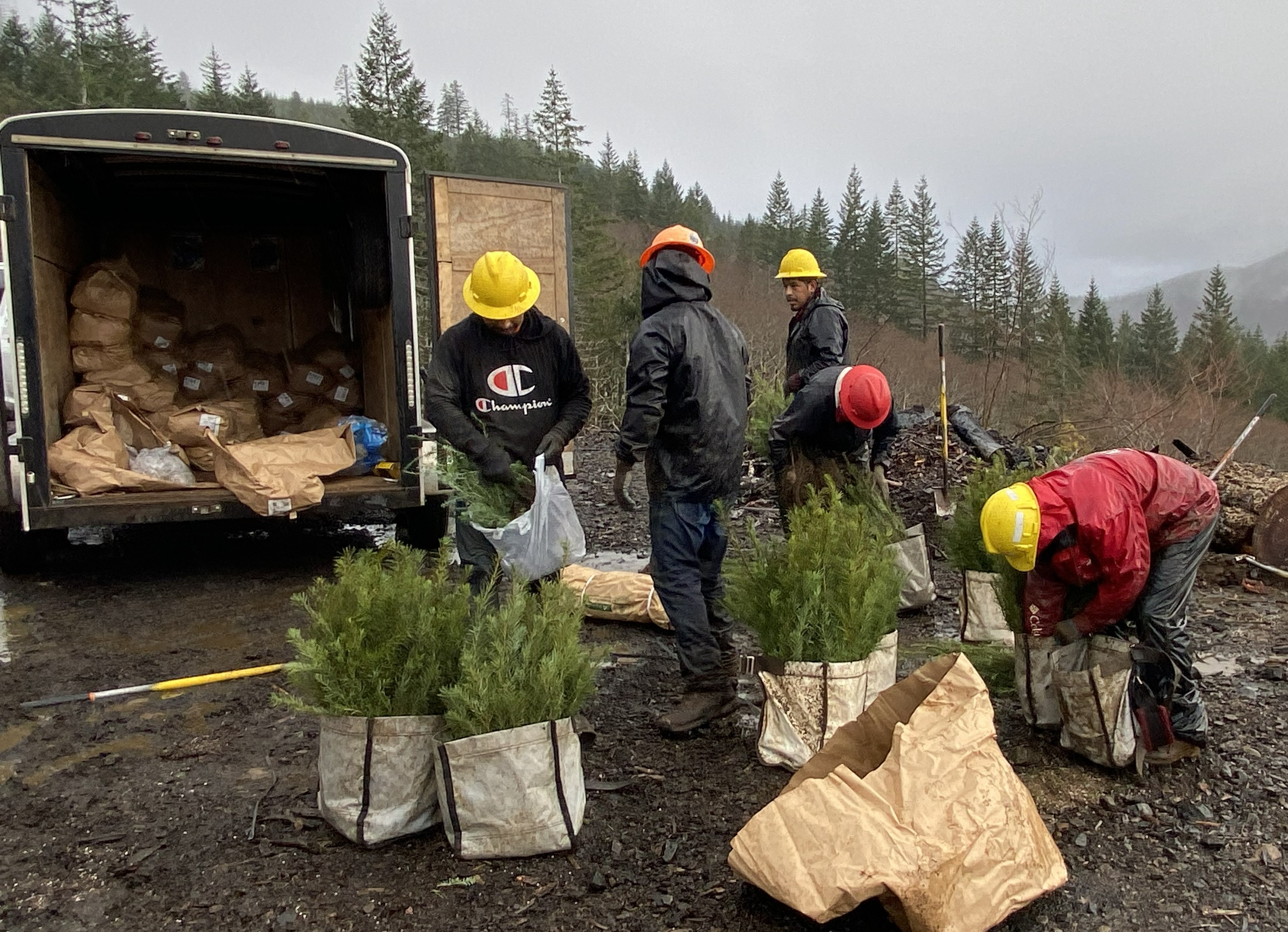
The planting is done mostly by private contractors working for ODF. Some planting and replanting the next year, mainly in the Tillamook State Forest, is also done by Adults In Custody from the South Fork Forest Camp, a facility jointly run by the Department of Corrections and ODF.
“This is not easy work,” said Bill Sayers, Reforestation Forester for ODF’s Forest Grove District who along with two of his coworkers were monitoring contractors working in Tillamook State Forest. “The terrain can be steep and slippery especially with a pack of 200 or so trees on your back and a shovel in your hand. Also, the contracts emphasize both speed and efficiency. They have to plant fast and plant correctly to get the maximum pay out specified in the contract. Most of these guys do amazing work.”
To determine if the work is done correctly ODF staff measures out a 1/100th of an acre circle and counts the number of seedlings planted in the circle.
“To get to our goal of usually 400 trees per acre there needs to be four seedlings in that circle,” said Sayers. “If there are too few or too many, we alert the foreman and they correct the issue right there. We then dig up the seedings in the circle to make sure they are planted correctly. If they are too deep or too shallow or the roots are bent over, we call those planting errors. We identify those issues and again get it corrected in real time. And yes, we replant the ones we checked ourselves.”
Once in the ground correctly and at the right time, the number one determining factor for their survival is whether they get the right amount of moisture at the right time.
“Obviously weather is the top determining factor—if it is an unusually dry spring and hot dry summer mortality goes up,” said Walter. “We can’t do anything about the weather. The second major factor is competing vegetation. Even if it is a “normal” participation year, seedlings can struggle if other plants are sucking up all the moisture. We evaluate each unit individually and then where deemed necessary use herbicide to limit that competing vegetation to increase the survival rate.”
Other factors impacting seedlings survival are deer and elk browse, root damage (mainly from mountain beavers that live underground), insects, tree diseases and wildfire.
“However, these stressors are usually limited to certain units and not as much of a threat when compared to the overall impact lack of water or drought region wide,” said Walter.
Looking to the future, ODF has several cooperative agreements and is a partner in research projects in Oregon and the Northwest to improve the genetics to increase the survivability of future trees.
“It’s difficult and a long-term effort to improve our trees,” said Walter. “Ideally, we want disease resistance, climate adaptation and growth all in the same tree. Realistically it is hard to get one of those traits without dropping one or two of the others.”
Meanwhile, ODF continues to manage state forests to yield a sustainable balance of economic, environmental and social benefits over time and for all Oregonians.
To learn more on how your state forests are managed see: Oregon Department of Forestry : State forests : Forest resources : State of Oregon