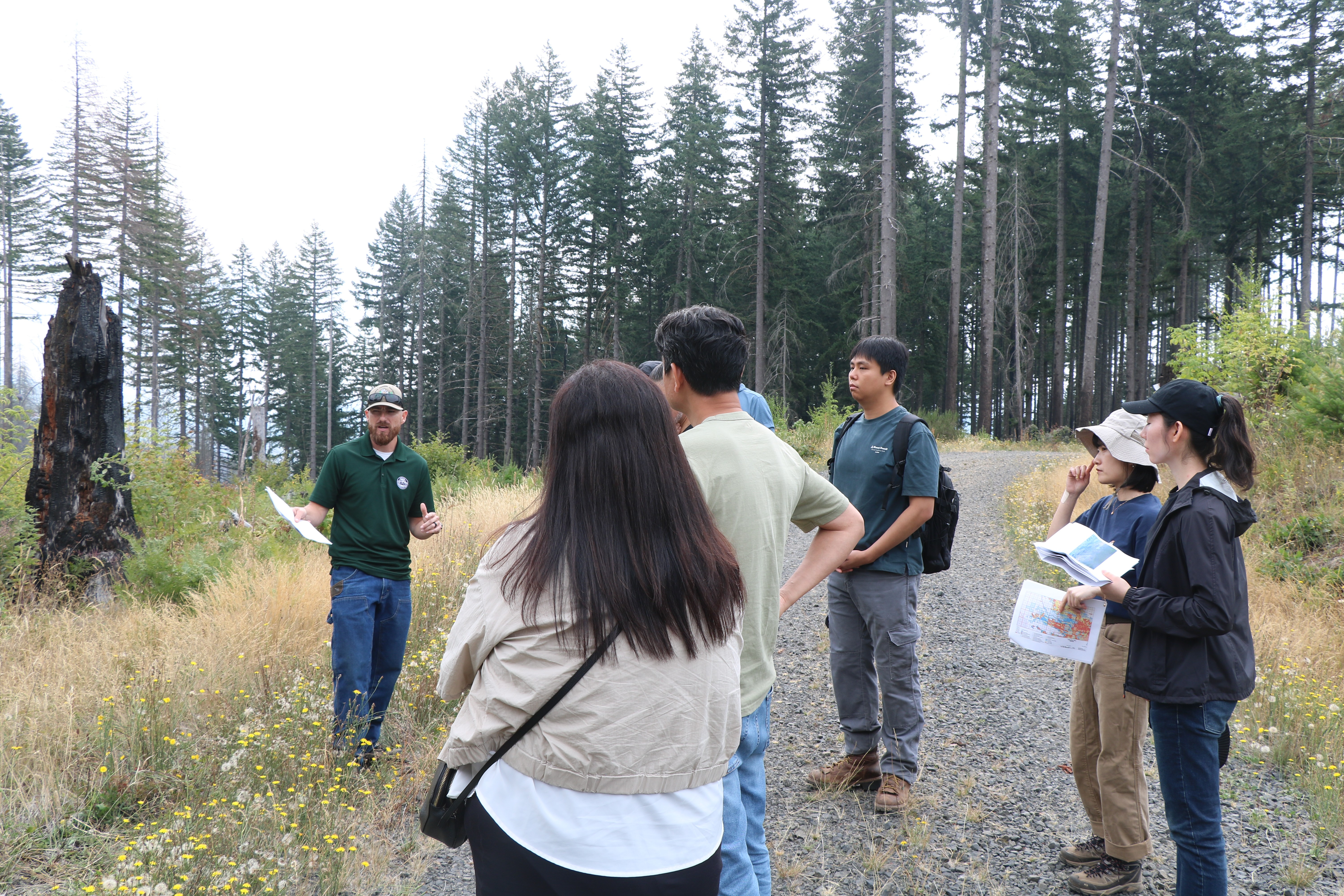
South Korean Researchers Gain Insight To Forest Recovery And Restoration From ODF’s Team Effort After 2020 Wildfires (Photo) - 09/12/25
SANTIAM STATE FOREST, Ore.—A group of Oregon Department of Forestry (ODF) experts shared management insights, challenges and lessons learned from the recovery efforts in the Santiam State Forest after the 2020 wildfires with a team of South Korean researchers and graduate students from Oregon State University recently.
“Oregon is known all over the world as one of the best, if not the best, in forest management both in the private and public sectors,” said Dr. Heesung Woo, Assistant Professor of Advanced Forestry Systems, Forest Engineering, Resources and Management at Oregon State University. “These researchers will be key to developing better forest management policy in South Korea and for them to see in person the forest and impact of large fires on the forest, then get to discuss how to recover from large fires with the ODF staff is invaluable.”
The day-long field tour in the Santiam included stops and discussions at burned areas, completed salvage logging areas, and places that had been replanted with trees.
“One big takeaway I’ve learned from this visit is the importance of good access to forests through a basic road system,” said Dr. Sanghoon Chung, from the South Korean National Institute of Forest Sciences. “In Oregon, I was struck by how forest roads played a vital role not only in enabling the deployment of ground-based equipment for building firebreaks and controlling wildfires, but also in supporting post-fire recovery by transporting seedlings and facilitating salvage logging. It was a powerful example for us to learn from.”
While the historical and social context of Korea’s forests differs from that of Oregon, the commitment to post-wildfire restoration remains equally strong. Forest recovery and restoration are entangled with complex social, policy, and economic interests.
“Conflicts among stakeholders are inevitable during the forest restoration process, and relying on one-sided claims rarely leads to reasonable outcomes. What is essential, however, is our collective commitment to ensuring that forests can once again deliver their full range of vital functions,” said Chung.
The group plans to apply the lessons and information ODF provided to shape their forests.
“These researchers and the students in this group who choose to go back will be key in developing forest policy now and in the future,” said Dr. Woo. “ODF has given us great insights and many things to consider.”
Even with all the challenges, Dr. Woo is optimistic about the future forests of South Korea.
“Many people here don’t realize how small South Korea is,” said Dr. Woo. “It’s only about 40 percent the size of Oregon, yet nearly 64 percent of the country is covered by forests. So, with the small size, we have a better chance of making changes quicker to promote healthy forests. We also see how Oregon has a cooperative social license with many groups to work together to improve forests, and we hope to gain interest from our people to value and care about the forest in the same way.”
Although there is no formal agreement between South Korea and Oregon on sharing forest research and management, the relationship has been strong for years
.
“One of the first tours I ever gave working for ODF was to a South Korean delegation in 2015,” said Kyle Kaupp, ODF’s Santiam Unit Forester. “It’s been amazing now to share more than 10 years of great work and lessons learned the hard way in the same forest with this group. They understand the challenges of forest management, and hopefully, we gave them some perspective and practical lessons on how to do that better back home.”
For more on the Santiam recovery efforts, visit: Oregon Department of Forestry : Restoring the Santiam State Forest : Recreation, education & interpretation : State of Oregon
For more on the South Korean Forest Service, visit: Korea Forest Service - Forest In Korea > Korean Forests at a Glance