Oregon Army National Guard Engineers Demonstrate Innovative Drone-assisted Breaching Concept During Annual Training (Photo) - 06/25/26
ORCHARD COMBAT TRAINING CENTER, Idaho — Oregon Army National Guard Soldiers demonstrated an innovative new approach to one of the Army's most dangerous battlefield tasks during annual training June 22, using a heavy-lift drone to remotely deliver and detonate a live Bangalore torpedo through a wire obstacle.
The proof-of-concept, developed by Soldiers from Bravo Company, 741st Brigade Engineer Battalion, 41st Infantry Brigade Combat Team, explored how emerging unmanned aircraft technology could reduce the risk to Soldiers during obstacle-breaching operations.
Army engineers are responsible for creating mobility for friendly forces by clearing obstacles such as concertina wire and minefields. Traditionally, placing explosive charges on these obstacles requires Soldiers to move within close range of enemy positions. During this demonstration, a heavy-lift drone carried the explosive charge to the obstacle, allowing Soldiers to remain under cover while opening a lane through the wire.
The concept grew out of a months-long innovation effort led by the battalion's drone working group under the direction of battalion commander Lt. Col. Eric Zimmerman. After identifying the operational requirement, the battalion partnered with Ashland-based Lorica Technologies to provide a heavy-lift unmanned aircraft capable of carrying the demolition charge.
Zimmerman said the project reflects the Oregon Army National Guard's commitment to finding practical solutions to battlefield challenges.
"Watching what's happening in Ukraine and seeing how innovative they've been inspires you to get better and think bigger," Zimmerman said.
The team conducted a deliberate series of progressively more complex tests, beginning with inert training aids before advancing to live explosive demonstrations. The final test successfully delivered and detonated a two-section Bangalore torpedo, creating a lane through the wire obstacle.
Zimmerman said the project was successful because it combined the creativity of the battalion staff with the expertise of the Soldiers responsible for executing the mission.
"I'm really proud. We have a true group project that highlights innovation across everything we do is possible," Zimmerman said. "The Soldiers of Bravo Company took an idea from the battalion staff and applied their expertise to make that idea functional and effective."
The demonstration showcased how Oregon National Guard Soldiers continue to develop new tactics and capabilities by combining military expertise with partnerships across Oregon's growing technology sector. Lessons learned from the project will help inform future Army engineer training and the continued integration of unmanned systems into combat operations.
The Oregon Army National Guard is composed of citizen-Soldiers who serve their state and nation while maintaining civilian careers, attending school, and raising families. Most Guard members serve one weekend each month and approximately two weeks each year for training, while remaining ready to respond to state emergencies such as wildfires, floods, winter storms, and other natural disasters at the direction of the Governor. When called into federal service, Oregon Army National Guard Soldiers deploy worldwide to support national defense and overseas contingency operations, providing trained and ready forces wherever they are needed.
Released B-Roll: https://www.dvidshub.net/video/1012370/b-roll-oregon-engineers-breach-wire-obstacle-with-drone-delivered-bangalore
Released Photos:
260622-Z-ZJ128-1002
s Lorica Technologies Inc. Mule 28 unmanned aerial system releases an inert M1A3 Bangalore torpedo onto a concertina wire obstacle during a proof-of-concept training iteration June 22, 2026, on Range 22 at Orchard Combat Training Center, Idaho. Soldiers with Bravo Company, 741st Brigade Engineer Battalion, 41st Infantry Brigade Combat Team, worked through a deliberate crawl-walk-run safety progression, beginning with inert drops, then advancing through inert charges paired with blasting caps and detonating cord, before delivering a live Bangalore charge against the wire. The Mule 28 was custom-built by the Ashland, Oregon, manufacturer to lift and release the demolition charge. (U.S. Army National Guard photo by Maj. W. Chris Clyne, Oregon National Guard Public Affairs)
260622-Z-ZJ128-1003
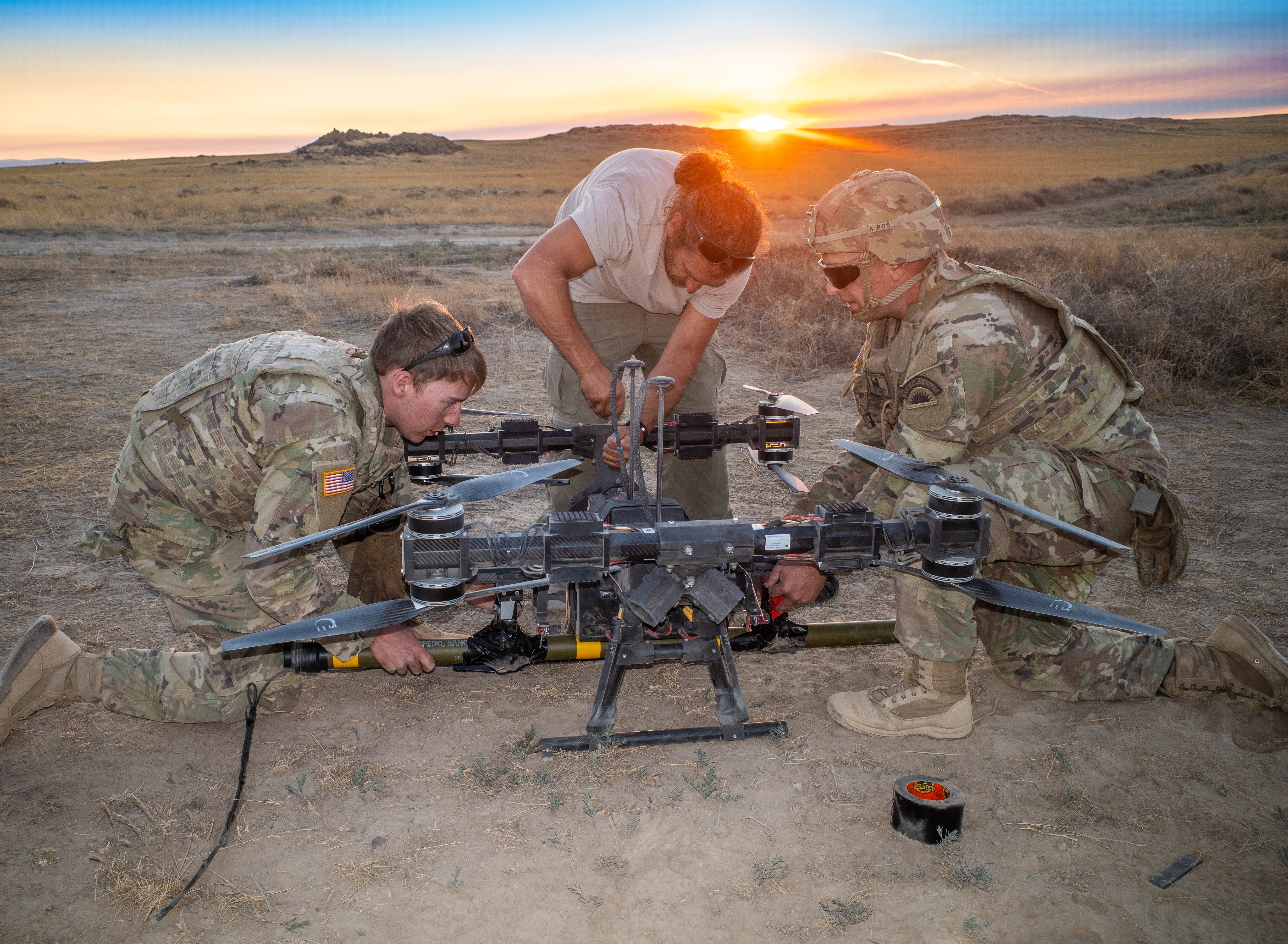
eSgt. 1st Class Raynaldo Villarreal, left, and 1st Sgt. Joshua Martin prime a live M1A3 Bangalore torpedo by connecting shock tube to the charge before a drone-delivered breach attempt against a concertina wire obstacle June 22, 2026, on Range 22 at Orchard Combat Training Center, Idaho. Soldiers with Bravo Company, 741st Brigade Engineer Battalion, 41st Infantry Brigade Combat Team, used shock tube spooled from the drone to the obstacle for every iteration involving live explosives, including blasting-cap-only flights, to safeguard against jamming or premature detonation in a contested electronic warfare environment. (U.S. Army National Guard photo by Maj. W. Chris Clyne, Oregon National Guard Public Affairs)
260622-Z-ZJ128-1004
A Lorica Technologies Inc. Mule 28 unmanned aerial system carries a live, primed M1A3 Bangalore torpedo toward a concertina wire obstacle moments before release June 22, 2026, on Range 22 at Orchard Combat Training Center, Idaho. Soldiers with Bravo Company, 741st Brigade Engineer Battalion, 41st Infantry Brigade Combat Team, conducted the proof-of-concept drone-delivered breach as the culmination of months of planning by the battalion's drone working group. The Mule 28 was custom-built by the Ashland, Oregon, manufacturer to lift and release the demolition charge. (U.S. Army National Guard photo by Maj. W. Chris Clyne, Oregon National Guard Public Affairs)
260622-Z-ZJ128-1006
From left, Capt. Samuel Cushing, plans officer for the 741st Brigade Engineer Battalion, Austin Hansen, director of manufacturing for Lorica Technologies Inc., and 1st Lt. Andrew Lucas, of the battalion's S-3 section, work together to attach a live M1A3 Bangalore torpedo to a Lorica Mule 28 unmanned aerial system before a proof-of-concept drone-delivered breach June 22, 2026, on Range 22 at Orchard Combat Training Center, Idaho. Hansen conducted preflight checks while Cushing and Lucas rigged the demolition charge for the final attempt. Soldiers with Bravo Company, 741st Brigade Engineer Battalion, 41st Infantry Brigade Combat Team, conducted the drone-delivered breach as the culmination of months of planning by the battalion's drone working group. (U.S. Army National Guard photo by Maj. W. Chris Clyne, Oregon National Guard Public Affairs)
260622-Z-ZJ128-1007
Soldiers with the 741st Brigade Engineer Battalion, 41st Infantry Brigade Combat Team, and representatives from Lorica Technologies Inc., stand with a Mule 28 unmanned aerial system in front of a breached concertina wire obstacle June 22, 2026, on Range 22 at Orchard Combat Training Center, Idaho. The group successfully delivered a live M1A3 Bangalore torpedo by drone to defeat the wire obstacle, the culmination of months of planning by the battalion's drone working group and a custom airframe built to specification by the Ashland, Oregon, manufacturer. (U.S. Army National Guard photo by Maj. W. Chris Clyne, Oregon National Guard Public Affairs)
260622-Z-ZJ128-1008
A live M1A3 Bangalore torpedo detonates against a concertina wire obstacle after being delivered by a Lorica Technologies Inc. Mule 28 unmanned aerial system June 22, 2026, on Range 22 at Orchard Combat Training Center, Idaho. Soldiers with Bravo Company, 741st Brigade Engineer Battalion, 41st Infantry Brigade Combat Team, conducted the proof-of-concept drone-delivered breach as the culmination of months of planning by the battalion's drone working group. The Mule 28 was custom-built by the Ashland, Oregon, manufacturer to lift and release the demolition charge. (U.S. Army National Guard photo by Maj. W. Chris Clyne, Oregon National Guard Public Affairs)