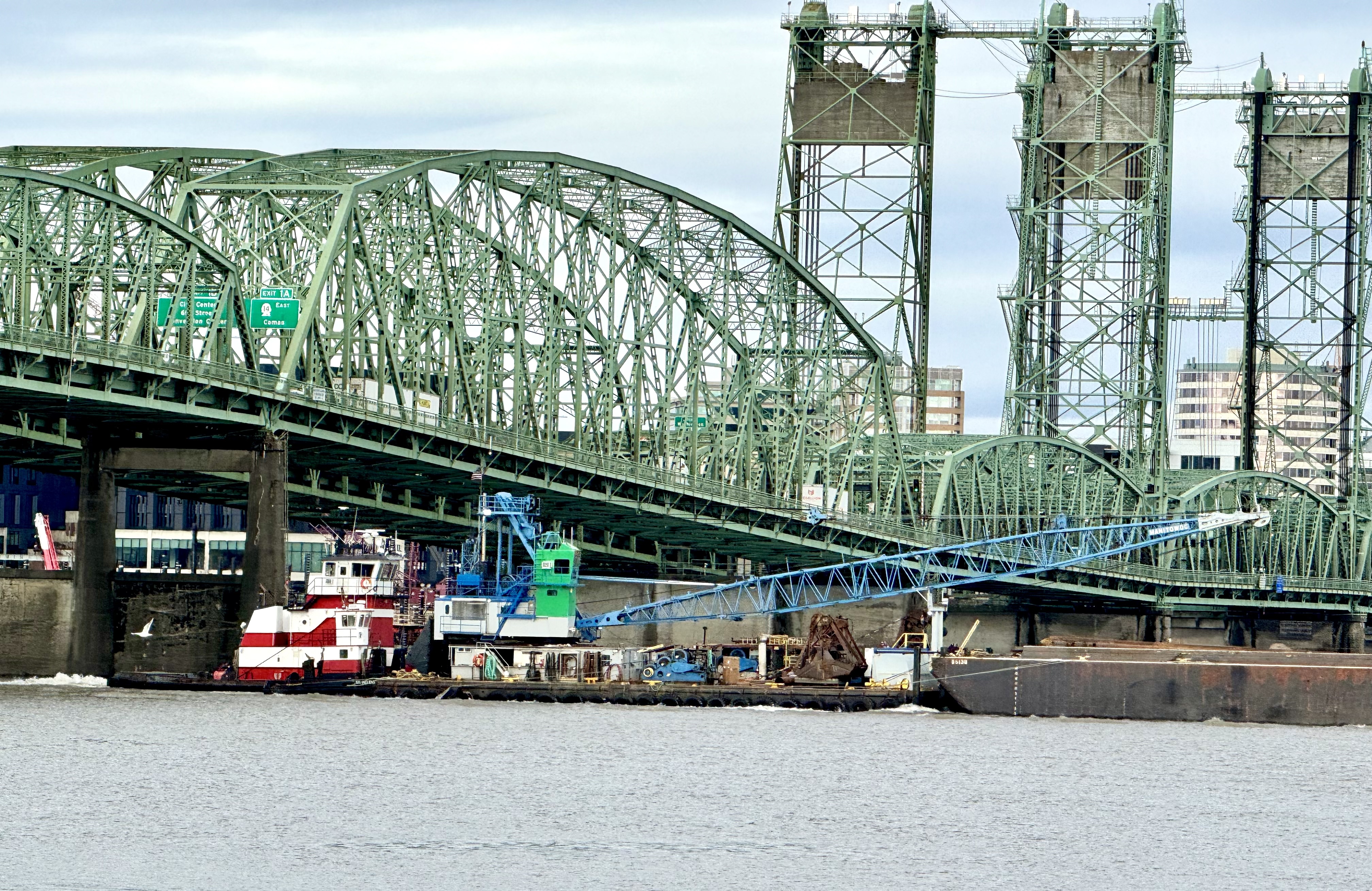
Atmospheric River Events Mean Even Less Clearance For Vessels Crossing Under The Proposed Interstate Bridge Plan (Photo) - 12/22/25
Atmospheric River Events Mean Even Less Clearance for Vessels Crossing Under the Proposed Interstate Bridge Plan
Neighbors for a Better Crossing (NFBC) has submitted formal comments to the U.S. Coast Guard in response to its request for public input on the Interstate Bridge Replacement Program’s preferred alternative—a 116-foot fixed-span bridge over the Columbia River, coupled with mitigation payments to select major river users in exchange for reduced navigational clearance. NFBC urges the Coast Guard to deny approval of this proposal, which would permanently constrain navigation on a federally protected waterway.
Recent atmospheric river events have caused rapid and significant increases in Columbia River water levels, temporarily reducing the effective vertical clearance beneath any fixed-span structure. Under these high-water conditions, a 116-foot fixed span would provide even less navigational clearance than advertised, further constraining the ability of taller commercial and recreational vessels to transit the river.
Unlike the existing movable spans, which can accommodate fluctuating river stages, a fixed bridge cannot adapt to elevated water levels. This makes navigation impacts more severe during flood events that are becoming increasingly frequent. This reality underscores why reduced fixed clearance presents a heightened and foreseeable risk to meeting the reasonable needs of navigation.
The U.S. Coast Guard has both the authority and the responsibility to ensure that any proposed structure meets the reasonable needs of navigation on the Columbia River. This includes the authority to reject the Interstate Bridge Replacement Program’s recent attempt to offer mitigation payments to major river users in exchange for lowering the navigation clearance established in the June 2022 Preliminary Navigation Clearance Determination (PNCD), which requires a minimum of 178 feet of vertical clearance.
On behalf of Neighbors for a Better Crossing—representing residents, small businesses, floating-home communities, river-dependent users, and stakeholders on both sides of the river—we respectfully urge the U.S. Coast Guard to deny the IBR program’s proposed 116-foot low fixed-span bridge.
Based on the Coast Guard’s statutory mandate, the formal PNCD issued in June 2022, and evidence provided by independent engineers, maritime users, and the regional business community, we believe the IBR proposal:
- Constitutes an unreasonable obstruction to navigation
- Fails to meet the Coast Guard’s legal and regulatory standards
- Restricts future commerce on a federally protected waterway
- Creates permanent harm for short-term roadway convenience
- Violates the Coast Guard’s obligation to safeguard future navigational needs
This proposal does not represent a long-term solution. It is a short-sighted workaround that would lock the region into 125 years of restricted river commerce.
1. The Coast Guard Has Already Determined That 116 Feet Is Insufficient
In its 2022 PNCD, the Coast Guard concluded that IBR’s proposed clearance creates an unreasonable obstruction, fails to meet current and future maritime needs, prevents several classes of vessels from safely passing, and reduces clearance relative to the existing bridges, which provide approximately 178 feet of vertical clearance.
IBR has offered no new maritime data, no updated vessel-height analysis, and no industry justification to override this determination.
2. Federal Law Requires Protection of Future Navigation, Not Just Present Users
Under the Rivers and Harbors Act, the General Bridge Act, and long-standing Coast Guard practice, the Coast Guard must consider future vessel types, industry growth, commerce expansion, and emergency needs—not just current traffic. The burden of proof lies entirely on the applicant to demonstrate that a new bridge will not obstruct navigation.
Lowering clearance is only permissible if navigational needs are shown to decline. No data supports such a conclusion for the Columbia River. A low fixed span permanently restricts maritime innovation and industrial flexibility for the next century.
3. The Proposed Bridge Conflicts with the Long-Term Economic Role of the Columbia River
The Columbia River is a critical transportation corridor for renewable energy components, tall industrial equipment, shipbuilding and repair, oversized cargo, dredging and maintenance fleets, emergency response vessels, and commercial and tribal fishing infrastructure.
River commerce has repeatedly evolved over the past century and will continue to do so. A fixed span of 116 feet assumes future industry will never require additional clearance. That assumption is demonstrably false.
4. “Mitigation Payments” Highlight a Structural Flaw in the Design
IBR’s proposal included offering cash payments to at least three major river users—Greenberry Industrial, JT Marine, and Western Machine Works—in an apparent effort to settle objections rather than address the underlying navigational deficiency.
While such payments may be legal, they essentially prove the point that the design obstructs navigation and would not otherwise meet river-wide requirements. The Coast Guard cannot permit a bridge that satisfies navigation standards only if companies are paid not to object.
5. The Proposal Locks the Region into a Single, Non-Scalable Design
A low fixed-span bridge cannot be raised, cannot be modified without full replacement, cannot adapt to new industries, and becomes a permanent bottleneck for regional commerce. This directly conflicts with long-term planning principles embedded in the Coast Guard’s bridge-permitting responsibilities.
6. A Low Fixed Bridge Is a Temporary Workaround, not a Long-Term Solution
As noted by Joe Cortright of City Observatory, “You can’t bribe your way to a navigational clearance,” and “The proposed design constrains the waterway for a century.”
NFBC agrees:
This proposal is not future-proof, compliant, adaptable, aligned with the Coast Guard’s legal obligations, or protective of long-term commerce. It is an expedient solution that sacrifices the Columbia River’s integrity and economic potential.
REQUEST
Given the facts outlined above, we respectfully request that the U.S. Coast Guard:
- Reject the Interstate Bridge Replacement Program’s 116-foot fixed-span proposal
- Require IBR to submit a design that meets or exceeds existing navigational clearance
- Reopen evaluation of alternatives, including an Immersed Tube Tunnel
The Columbia River is a federally protected resource and one of the most important waterways in the Pacific Northwest. Decisions made today will shape its use for the next century.
We urge the Coast Guard to uphold its mandate to protect navigation—now and in the future.
Public comments will be received for the record January 11, 2026
Email: d13-smb-d13-bridges@uscg.mil