Northwest Regional ESD

Emergency Messages as of 7:36 PM, Sat. Dec 13

No information currently posted.

Subscribe to receive FlashAlert messages from Northwest Regional ESD.

News Release

New Early Literacy Data Highlights Progress And Opportunities For Northwest Oregon Schools (Photo) - 10/02/25

Regional districts show strong gains in early reading as focus on science-based instruction grows


HILLSBORO – The numbers are out, and the data paints a mixed picture. Northwest Regional Education Service District’s region, which includes 20 school districts in Clatsop, Columbia, Tillamook and Washington counties, saw some districts with notable gains in early literacy and others with lower scores than hoped.


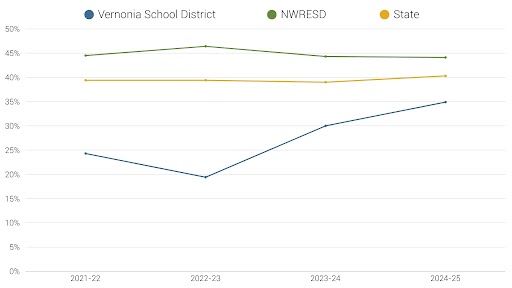
Across this region, 44.2% of third graders are proficient in English Language Arts, meaning they read well enough to identify a story’s central idea and answer questions about that story and write an essay. Statewide, 40.3% of third-graders are proficient.   


That’s a -0.1 percentage point change from last year for the region and still about 5 percentage points below pre-pandemic levels.


As districts adopt research-backed instructional strategies and focus on closing long-standing gaps in student achievement that are often predicated by a child’s socioeconomic status, several have made notable gains. 

Nestucca Valley, Tillamook, Seaside, Rainier, Gaston and Vernonia showed strong growth in third-grade reading outcomes compared to last year. Additionally, Seaside, Knappa, Sherwood and St. Helens posted strong and steady growth over four years. 


Northwest Regional Education Service District’s early literacy experts offer a suite of opportunities for schools to engage in improvement, no matter where they’re starting from. Schools and districts are accessing a variety of tailored supports, including:

  • Teaching educators brain science and how children learn to read

  • Helping teachers adopt research-backed practices for teaching reading

  • Creating school-wide systems so everyone is working together

“The ability to read and write is a fundamental right,” says Laurel Fischer, an early literacy professional learning coach at Northwest Regional Education Service District who has worked in the field for nearly two decades.

“Getting more kids reading proficiently is not going to be a quick fix. Not all educators in our region have historically had access to the science of reading research. So when we work with them, we start from the beginning and then help them build systems and change teaching practices. This is not easy or fast work, but we can see incremental gains starting to take hold.”


Recommended Contacts for Interviews and Commentary:

  • Laurel Fischer (lfischer@nwresd.k12.or.us), Early Literacy Professional Learning Coach at Northwest Regional Education Service District

    • Focus areas: science of reading instruction, data-based decision-making, high-quality teaching strategies

  • Ryan Blasquez (rblasquez@nwresd.k12.or.us), Director of Instructional Services at Northwest Regional Education Service District

    • Focus areas: literacy systems, statewide improvement goals

  • Stephanie Sparks (ssparks@astoria.k12.or.us), Director of Instructional Support, Astoria School District 

    • District adopted new English Language Arts curriculum in 2024-25, implemented professional development for teachers, saw 10 percentage point gain for K-5th graders on the Dynamic Indicators of Basic Early Literacy Skills (DIBELS) benchmark assessment

  • Heidi Schultz (heidis@nestucca.k12.or.us), K-8 Associate Principal, Nestucca Valley School District

    • District received early literacy professional development including training in Language Essentials For Teachers of Reading and Spelling (LETRS), saw a 17.9 percentage point increase in Oregon Statewide Assessment System (OSAS) scores (32.6% proficient in 2024-25 compared to 14.7% proficient in 2023-24)

  • Kendra Schlegel (kschlegel@vernoniak12.org), Elementary Director of Title I and Title III, Vernonia School District

    • Works with Oregon Response to Instruction and Intervention, heavy emphasis on core reading instruction, steady increases over four years from 24.3% proficient in 2021-22 to 34.9% in 2024-25. The Oregon Department of Education recently featured the work Vernonia School District is doing to improve early reading instruction.

To learn more about how schools in our region are improving literacy, read: Far Too Many Students Lag in Reading: Here’s What We’re Doing About It. Learn more about our Early Literacy supports


About Northwest Regional Education Service District

Northwest Regional ESD is Oregon’s largest education service district, serving students, educators, child care providers and families in Clatsop, Columbia, Tillamook and Washington counties. Our region includes both large, urban school districts in Washington County and smaller, rural districts along the Columbia River, the Coast Range and the North Oregon coast.


Headquartered in Hillsboro, with service centers in St. Helens, Astoria and Tillamook, we support 20 school districts and more than 98,000 students. Our agency partners with schools to deliver cost-effective services in special education, technology, professional development and school improvement, as well as operational support in business services and human resources.
New Early Literacy Data Highlights Progress And Opportunities For Northwest Oregon Schools (Photo) - 10/02/25

Regional districts show strong gains in early reading as focus on science-based instruction grows


HILLSBORO – The numbers are out, and the data paints a mixed picture. Northwest Regional Education Service District’s region, which includes 20 school districts in Clatsop, Columbia, Tillamook and Washington counties, saw some districts with notable gains in early literacy and others with lower scores than hoped.


Across this region, 44.2% of third graders are proficient in English Language Arts, meaning they read well enough to identify a story’s central idea and answer questions about that story and write an essay. Statewide, 40.3% of third-graders are proficient.   


That’s a -0.1 percentage point change from last year for the region and still about 5 percentage points below pre-pandemic levels.


As districts adopt research-backed instructional strategies and focus on closing long-standing gaps in student achievement that are often predicated by a child’s socioeconomic status, several have made notable gains. 

Nestucca Valley, Tillamook, Seaside, Rainier, Gaston and Vernonia showed strong growth in third-grade reading outcomes compared to last year. Additionally, Seaside, Knappa, Sherwood and St. Helens posted strong and steady growth over four years. 


Northwest Regional Education Service District’s early literacy experts offer a suite of opportunities for schools to engage in improvement, no matter where they’re starting from. Schools and districts are accessing a variety of tailored supports, including:

  • Teaching educators brain science and how children learn to read

  • Helping teachers adopt research-backed practices for teaching reading

  • Creating school-wide systems so everyone is working together

“The ability to read and write is a fundamental right,” says Laurel Fischer, an early literacy professional learning coach at Northwest Regional Education Service District who has worked in the field for nearly two decades.

“Getting more kids reading proficiently is not going to be a quick fix. Not all educators in our region have historically had access to the science of reading research. So when we work with them, we start from the beginning and then help them build systems and change teaching practices. This is not easy or fast work, but we can see incremental gains starting to take hold.”


Recommended Contacts for Interviews and Commentary:

  • Laurel Fischer (lfischer@nwresd.k12.or.us), Early Literacy Professional Learning Coach at Northwest Regional Education Service District

    • Focus areas: science of reading instruction, data-based decision-making, high-quality teaching strategies

  • Ryan Blasquez (rblasquez@nwresd.k12.or.us), Director of Instructional Services at Northwest Regional Education Service District

    • Focus areas: literacy systems, statewide improvement goals

  • Stephanie Sparks (ssparks@astoria.k12.or.us), Director of Instructional Support, Astoria School District 

    • District adopted new English Language Arts curriculum in 2024-25, implemented professional development for teachers, saw 10 percentage point gain for K-5th graders on the Dynamic Indicators of Basic Early Literacy Skills (DIBELS) benchmark assessment

  • Heidi Schultz (heidis@nestucca.k12.or.us), K-8 Associate Principal, Nestucca Valley School District

    • District received early literacy professional development including training in Language Essentials For Teachers of Reading and Spelling (LETRS), saw a 17.9 percentage point increase in Oregon Statewide Assessment System (OSAS) scores (32.6% proficient in 2024-25 compared to 14.7% proficient in 2023-24)

  • Kendra Schlegel (kschlegel@vernoniak12.org), Elementary Director of Title I and Title III, Vernonia School District

    • Works with Oregon Response to Instruction and Intervention, heavy emphasis on core reading instruction, steady increases over four years from 24.3% proficient in 2021-22 to 34.9% in 2024-25. The Oregon Department of Education recently featured the work Vernonia School District is doing to improve early reading instruction.

To learn more about how schools in our region are improving literacy, read: Far Too Many Students Lag in Reading: Here’s What We’re Doing About It. Learn more about our Early Literacy supports


About Northwest Regional Education Service District

Northwest Regional ESD is Oregon’s largest education service district, serving students, educators, child care providers and families in Clatsop, Columbia, Tillamook and Washington counties. Our region includes both large, urban school districts in Washington County and smaller, rural districts along the Columbia River, the Coast Range and the North Oregon coast.


Headquartered in Hillsboro, with service centers in St. Helens, Astoria and Tillamook, we support 20 school districts and more than 98,000 students. Our agency partners with schools to deliver cost-effective services in special education, technology, professional development and school improvement, as well as operational support in business services and human resources.