
Lebanon Fire District

Emergency Messages as of 9:44 PM, Wed. Jan 7

No information currently posted.

logo

Subscribe to receive FlashAlert messages from Lebanon Fire District.

News Release

A Year In Review: What 2025 Reveals About Emergency Response In Lebanon (Photo) - 01/05/26

In 2025, the Lebanon Fire District responded to 7,181 emergency incidents, reflecting continued high demand for emergency services as the community grows.


In 2022, the district handled 6,711 incidents. That number shifted slightly in 2023 to 6,626, increased in 2024 to 6,745, and rose again in 2025 by more than 400 additional calls. Compared to 2022, overall call volume has grown by nearly 7 percent in just three years, reflecting steady growth rather than a temporary spike.


“Fire protection and emergency medical services are directly tied to the size of the community we serve,” said Fire Chief John Tacy. “As Lebanon continues to grow, our firefighters are responding to more calls across a larger and more active city.”


In 2025, ambulances and firefighter-paramedics responded to the majority of incidents, providing patient care, transporting patients, and remaining at hospitals until transfer of care was complete. While units are committed to those calls, they cannot respond to new emergencies, even as additional calls continue to come in.


In recent years, providing ambulance service has become more challenging. Rising operational costs, funding limitations, inflation, and ongoing staffing shortages have affected EMS systems across Oregon and the nation, including Lebanon. At the same time, the district has faced increasing difficulty recruiting and retaining qualified paramedics.


Rising costs, funding limitations, and ongoing staffing shortages are forcing the Lebanon Fire District to reduce ambulance staffing. The district made the decision in August 2024 to take one medic ambulance, known as M30, out of service, with that change taking effect in January 2026. Once implemented, the reduction will leave even fewer ambulances available to respond to emergencies, further straining limited resources during periods of high medical call volume.


With fewer ambulances in service, remaining units stay committed to calls for longer periods of time, particularly when multiple medical emergencies occur at once or when hospital wait times increase. As a result, crews must carefully coordinate responses and prioritize calls when emergencies happen simultaneously.


The impact of this workload becomes clearer when looking at how often incidents occurred at the same time. In 2025, only 2,054 incidents occurred without any other emergency happening concurrently. The remaining 5,127 calls overlapped with one or more active incidents. Many overlapped with two or three others, and on several occasions the district was managing six or more emergencies at once. Each incident commits firefighters, ambulances, and engines for the duration of the call, meaning those same resources are not available for new emergencies until they return to service.


For many residents, it may appear that each emergency has a dedicated crew waiting at the station. In practice, the same firefighters, engines, and ambulances are shared across all calls. When incidents overlap, response distances can increase and fewer options are available until additional resources arrive or neighboring agencies are able to assist.


This reality becomes especially clear during structure fires. National standards for career fire agencies recommend a minimum of four firefighters on each engine or truck company and at least 15 firefighters on the initial alarm for a low-hazard structure fire, with additional staffing required for higher-risk or larger incidents. These standards exist because many critical tasks must occur at the same time, including search and rescue, hose line advancement, ventilation, water supply, fire suppression, and firefighter safety operations.


For a typical single-family house fire, recommended staffing would include approximately 15 firefighters plus a Battalion Chief, who serves as the Incident Commander and oversees the entire fireground. One engine company would be assigned to fire attack, with a lieutenant and firefighter advancing a hose line inside the structure while an engineer operated the pump. A second engine company would provide a backup hose line, again staffed with a lieutenant, firefighter, and engineer.


A truck company would typically handle rescue and ventilation functions and would be staffed with a lieutenant, an engineer, and a firefighter. Two medic units would also be assigned. One medic crew would serve as the Rapid Intervention Crew, dedicated to firefighter rescue if needed, while the second medic crew would provide medical support and rotate with interior crews to manage fatigue and safety.


Altogether, this structure provides the recommended 15 firefighters and one Battalion Chief, which meets the national minimum for a low-hazard residential fire. In Lebanon, initial fire responses often begin with fewer firefighters until additional on-duty crews, volunteers, off-duty personnel, or mutual-aid partners arrive. When fires occur during periods of heavy medical activity or multiple simultaneous incidents, available staffing may already be spread across the community.


Lebanon Fire District operates as a special service district, which means it is funded differently than city departments such as police or public works. Rather than drawing from the City of Lebanon’s general fund, the fire district relies primarily on a dedicated tax base set at the time of its formation. That funding structure does not automatically increase as population, call volume, or service demands grow, making long-term planning closely tied to changes in the community it serves.


Throughout 2025, Lebanon Fire District firefighters responded to every call for help while also balancing training requirements, equipment maintenance, and coordination with regional partners. That workload often meant crews were moving directly from one incident to the next, with limited opportunities to return to stations, reset staffing, or restore full coverage before another call came in. The data from the year illustrates how emergency response operates as a shared, finite system — one that becomes increasingly stretched as call volume grows and incidents overlap more frequently.


“As our community grows and calls increase and overlap more frequently, understanding how emergency response works becomes increasingly important,” Fire Chief Tacy said.


Residents interested in learning more about call volume, response trends, and operational data can explore the district’s public data dashboards at https://data.lebanonfireoregon.gov. The data hub is continually being updated and expanded, with additional dashboards planned in the coming months to provide greater transparency and insight into district operations. Additional information about services, programs, and community resources is available at https://lebanonfireoregon.gov.
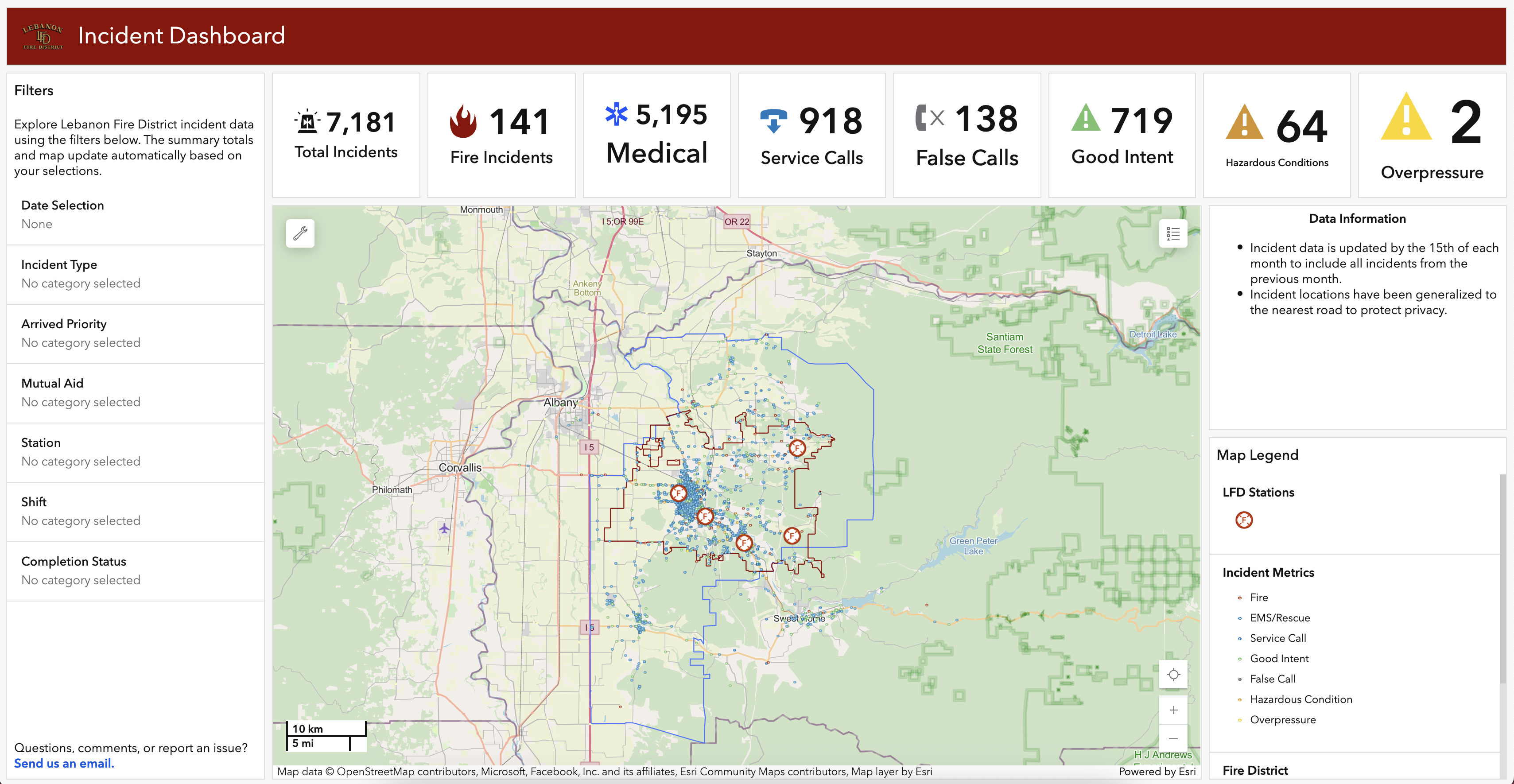
Attached Media Files: LFD Dashboard View, LFD Station,

A Year In Review: What 2025 Reveals About Emergency Response In Lebanon (Photo) - 01/05/26

In 2025, the Lebanon Fire District responded to 7,181 emergency incidents, reflecting continued high demand for emergency services as the community grows.


In 2022, the district handled 6,711 incidents. That number shifted slightly in 2023 to 6,626, increased in 2024 to 6,745, and rose again in 2025 by more than 400 additional calls. Compared to 2022, overall call volume has grown by nearly 7 percent in just three years, reflecting steady growth rather than a temporary spike.


“Fire protection and emergency medical services are directly tied to the size of the community we serve,” said Fire Chief John Tacy. “As Lebanon continues to grow, our firefighters are responding to more calls across a larger and more active city.”


In 2025, ambulances and firefighter-paramedics responded to the majority of incidents, providing patient care, transporting patients, and remaining at hospitals until transfer of care was complete. While units are committed to those calls, they cannot respond to new emergencies, even as additional calls continue to come in.


In recent years, providing ambulance service has become more challenging. Rising operational costs, funding limitations, inflation, and ongoing staffing shortages have affected EMS systems across Oregon and the nation, including Lebanon. At the same time, the district has faced increasing difficulty recruiting and retaining qualified paramedics.


Rising costs, funding limitations, and ongoing staffing shortages are forcing the Lebanon Fire District to reduce ambulance staffing. The district made the decision in August 2024 to take one medic ambulance, known as M30, out of service, with that change taking effect in January 2026. Once implemented, the reduction will leave even fewer ambulances available to respond to emergencies, further straining limited resources during periods of high medical call volume.


With fewer ambulances in service, remaining units stay committed to calls for longer periods of time, particularly when multiple medical emergencies occur at once or when hospital wait times increase. As a result, crews must carefully coordinate responses and prioritize calls when emergencies happen simultaneously.


The impact of this workload becomes clearer when looking at how often incidents occurred at the same time. In 2025, only 2,054 incidents occurred without any other emergency happening concurrently. The remaining 5,127 calls overlapped with one or more active incidents. Many overlapped with two or three others, and on several occasions the district was managing six or more emergencies at once. Each incident commits firefighters, ambulances, and engines for the duration of the call, meaning those same resources are not available for new emergencies until they return to service.


For many residents, it may appear that each emergency has a dedicated crew waiting at the station. In practice, the same firefighters, engines, and ambulances are shared across all calls. When incidents overlap, response distances can increase and fewer options are available until additional resources arrive or neighboring agencies are able to assist.


This reality becomes especially clear during structure fires. National standards for career fire agencies recommend a minimum of four firefighters on each engine or truck company and at least 15 firefighters on the initial alarm for a low-hazard structure fire, with additional staffing required for higher-risk or larger incidents. These standards exist because many critical tasks must occur at the same time, including search and rescue, hose line advancement, ventilation, water supply, fire suppression, and firefighter safety operations.


For a typical single-family house fire, recommended staffing would include approximately 15 firefighters plus a Battalion Chief, who serves as the Incident Commander and oversees the entire fireground. One engine company would be assigned to fire attack, with a lieutenant and firefighter advancing a hose line inside the structure while an engineer operated the pump. A second engine company would provide a backup hose line, again staffed with a lieutenant, firefighter, and engineer.


A truck company would typically handle rescue and ventilation functions and would be staffed with a lieutenant, an engineer, and a firefighter. Two medic units would also be assigned. One medic crew would serve as the Rapid Intervention Crew, dedicated to firefighter rescue if needed, while the second medic crew would provide medical support and rotate with interior crews to manage fatigue and safety.


Altogether, this structure provides the recommended 15 firefighters and one Battalion Chief, which meets the national minimum for a low-hazard residential fire. In Lebanon, initial fire responses often begin with fewer firefighters until additional on-duty crews, volunteers, off-duty personnel, or mutual-aid partners arrive. When fires occur during periods of heavy medical activity or multiple simultaneous incidents, available staffing may already be spread across the community.


Lebanon Fire District operates as a special service district, which means it is funded differently than city departments such as police or public works. Rather than drawing from the City of Lebanon’s general fund, the fire district relies primarily on a dedicated tax base set at the time of its formation. That funding structure does not automatically increase as population, call volume, or service demands grow, making long-term planning closely tied to changes in the community it serves.


Throughout 2025, Lebanon Fire District firefighters responded to every call for help while also balancing training requirements, equipment maintenance, and coordination with regional partners. That workload often meant crews were moving directly from one incident to the next, with limited opportunities to return to stations, reset staffing, or restore full coverage before another call came in. The data from the year illustrates how emergency response operates as a shared, finite system — one that becomes increasingly stretched as call volume grows and incidents overlap more frequently.


“As our community grows and calls increase and overlap more frequently, understanding how emergency response works becomes increasingly important,” Fire Chief Tacy said.


Residents interested in learning more about call volume, response trends, and operational data can explore the district’s public data dashboards at https://data.lebanonfireoregon.gov. The data hub is continually being updated and expanded, with additional dashboards planned in the coming months to provide greater transparency and insight into district operations. Additional information about services, programs, and community resources is available at https://lebanonfireoregon.gov.

Attached Media Files: LFD Dashboard View, LFD Station,