Oregon Nurses Assn.

Emergency Messages as of 8:28 AM, Mon. Apr 27

No information currently posted.

logo

Subscribe to receive FlashAlert messages from Oregon Nurses Assn..

News Release

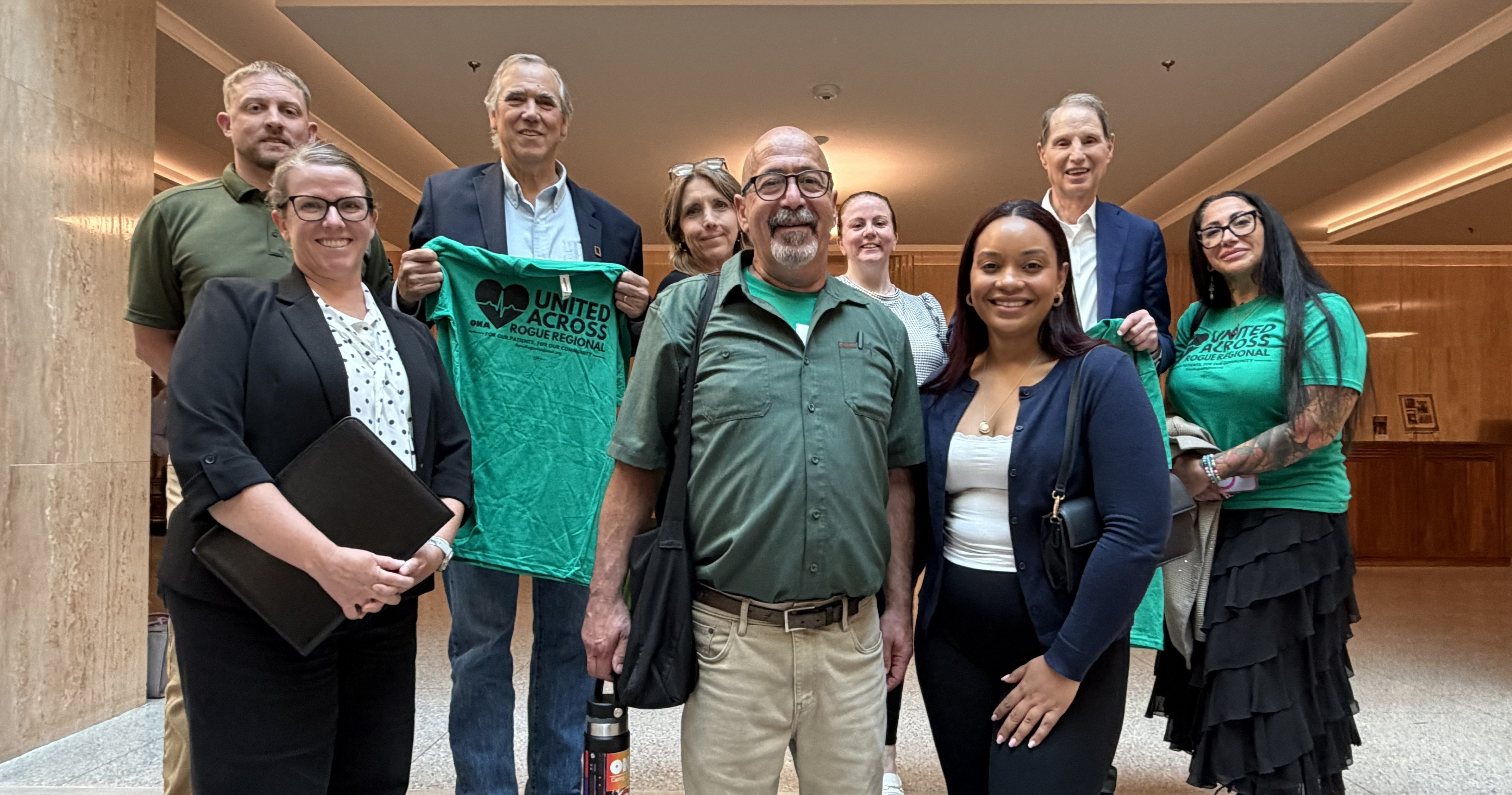
Thousands Sign Petition To Save Local ER Doctors (Photo) - 04/23/26

Nearly 7,000 people sign nurses’ petition in support of Eugene Emergency Physicians

(SPRINGFIELD, Ore.) – Local nurses delivered a petition signed by more than 6,800 supporters to PeaceHealth’s executives and board of directors April 22. The petition calls out PeaceHealth’s attempt to outsource and corporatize emergency room care at local hospitals and demands PeaceHealth renew its contract with local doctors at Eugene Emergency Physicians (EEP).


“Our community’s health can’t be sold to the highest bidder. Our healthcare belongs to our community, and it should stay in our community,” said Chris Rompala, RN, ONA board member and bargaining unit chair at PeaceHealth Sacred Heart Medical Center RiverBend. We don’t want temporary providers just passing through to collect a paycheck. We need to keep care local with experienced EEP doctors who know our community and are committed to serving the people of Lane County and making our hospitals places we can be proud of.”

Since announcing its plan to outsource emergency room doctors to the large, out-of-state medical group ApolloMD on Feb. 4, PeaceHealth executives have faced intense scrutiny and widespread criticism from healthcare providers, firefighters, elected officials and community members—with many sharing concerns that PeaceHealth's proposed change could threaten community health and safety.


One of the primary decisionmakers for the change was PeaceHealth Oregon CEO Dr. Jim McGovern. McGovern was placed on leave by PeaceHealth April 9 after more than 300 pages of emails surfaced which “show Dr. McGovern repeatedly trying to influence and dictate patient care against providers clinical judgment and violating the scope of his administrative license” according to the medical executive committee at PeaceHealth Sacred Heart Medical Center Riverbend. The committee is a senior leadership group of hospital physicians and medical staff.  


McGovern appeared to make the outsourcing decision after he learned staff had submitted a complaint about his actions.


Following these revelations, PeaceHealth RiverBend chief of staff and medical executive committee member Dr. Will Emerson called the ApolloMD request-for-proposal (RFP) process and decision “irreparably compromised” and said it “raises the strong possibility that the RFP decision may have been retaliatory in nature.” The medical executive committee is among those calling on PeaceHealth to reverse its decision and continue its relationship with Eugene Emergency Physicians.


The proposal is also facing legal challenges as elected officials and healthcare providers question whether the move complies with Oregon’s corporate practice of medicine law which prevents corporations from overly influencing or interfering in patients’ care.    


PeaceHealth’s attempt to outsource emergency care is part of a larger pattern of profit-focused decisions by PeaceHealth executives. These include closing Eugene’s only hospital—leaving nearly 200,000 residents in Oregon’s third-largest city without a hospital or emergency room—and shuttering local healthcare options including a sleep clinic and pediatric cardiology service in Springfield; medical and optometry clinics in Eugene; and home infusion services.


PeaceHealth executives have also repeatedly led mass layoffs of caregivers and support staff including hospice nurses and flaunted Oregon’s safe nurse staffing law. These repeated actions have led to multiple no confidence votes from local physicians and nurses and sparked widespread community action.


###


Thousands Sign Petition To Save Local ER Doctors (Photo) - 04/23/26

Nearly 7,000 people sign nurses’ petition in support of Eugene Emergency Physicians

(SPRINGFIELD, Ore.) – Local nurses delivered a petition signed by more than 6,800 supporters to PeaceHealth’s executives and board of directors April 22. The petition calls out PeaceHealth’s attempt to outsource and corporatize emergency room care at local hospitals and demands PeaceHealth renew its contract with local doctors at Eugene Emergency Physicians (EEP).


“Our community’s health can’t be sold to the highest bidder. Our healthcare belongs to our community, and it should stay in our community,” said Chris Rompala, RN, ONA board member and bargaining unit chair at PeaceHealth Sacred Heart Medical Center RiverBend. We don’t want temporary providers just passing through to collect a paycheck. We need to keep care local with experienced EEP doctors who know our community and are committed to serving the people of Lane County and making our hospitals places we can be proud of.”

Since announcing its plan to outsource emergency room doctors to the large, out-of-state medical group ApolloMD on Feb. 4, PeaceHealth executives have faced intense scrutiny and widespread criticism from healthcare providers, firefighters, elected officials and community members—with many sharing concerns that PeaceHealth's proposed change could threaten community health and safety.


One of the primary decisionmakers for the change was PeaceHealth Oregon CEO Dr. Jim McGovern. McGovern was placed on leave by PeaceHealth April 9 after more than 300 pages of emails surfaced which “show Dr. McGovern repeatedly trying to influence and dictate patient care against providers clinical judgment and violating the scope of his administrative license” according to the medical executive committee at PeaceHealth Sacred Heart Medical Center Riverbend. The committee is a senior leadership group of hospital physicians and medical staff.  


McGovern appeared to make the outsourcing decision after he learned staff had submitted a complaint about his actions.


Following these revelations, PeaceHealth RiverBend chief of staff and medical executive committee member Dr. Will Emerson called the ApolloMD request-for-proposal (RFP) process and decision “irreparably compromised” and said it “raises the strong possibility that the RFP decision may have been retaliatory in nature.” The medical executive committee is among those calling on PeaceHealth to reverse its decision and continue its relationship with Eugene Emergency Physicians.


The proposal is also facing legal challenges as elected officials and healthcare providers question whether the move complies with Oregon’s corporate practice of medicine law which prevents corporations from overly influencing or interfering in patients’ care.    


PeaceHealth’s attempt to outsource emergency care is part of a larger pattern of profit-focused decisions by PeaceHealth executives. These include closing Eugene’s only hospital—leaving nearly 200,000 residents in Oregon’s third-largest city without a hospital or emergency room—and shuttering local healthcare options including a sleep clinic and pediatric cardiology service in Springfield; medical and optometry clinics in Eugene; and home infusion services.


PeaceHealth executives have also repeatedly led mass layoffs of caregivers and support staff including hospice nurses and flaunted Oregon’s safe nurse staffing law. These repeated actions have led to multiple no confidence votes from local physicians and nurses and sparked widespread community action.


###


ONA Statement On The Reproductive Health Equity Act Court Ruling - 04/15/26

The Oregon Nurses Association (ONA) strongly condemns the federal court ruling on April 14 undermining the Reproductive Health Equity Act—a law that has been critical to ensuring patients across Oregon can access reproductive healthcare without cost barriers or discrimination.


For nearly a decade, the Reproductive Health Equity Act has guaranteed coverage for contraception, abortion care, and other essential reproductive health services without out-of-pocket costs in Oregon. This ruling threatens to erode those protections.


As nurses and frontline healthcare professionals, we see every day what happens when care— including reproductive care—is delayed, denied, or made unaffordable. The consequences are real: worse health outcomes, deepening inequities, and preventable suffering.


While the immediate impact of this ruling is not yet clear and the law remains in effect for now, this decision sets a dangerous precedent that cannot go unchallenged. Oregon has long been a leader in protecting reproductive freedom and advancing health equity, and ONA members have been on the frontlines of that work. We are proud of that legacy and we refuse to go backward.


We stand with our patients. We stand for science-based care. And we call on state leaders to continue fighting this ruling to ensure every Oregonian can access the care they need, when they need it, without barriers.


Let us be clear: care decisions belong to patients and their providers—not courts, not politicians, and not employers—because healthcare is not a privilege; it’s a fundamental human right. 


###

ONA Statement On The Reproductive Health Equity Act Court Ruling - 04/15/26

The Oregon Nurses Association (ONA) strongly condemns the federal court ruling on April 14 undermining the Reproductive Health Equity Act—a law that has been critical to ensuring patients across Oregon can access reproductive healthcare without cost barriers or discrimination.


For nearly a decade, the Reproductive Health Equity Act has guaranteed coverage for contraception, abortion care, and other essential reproductive health services without out-of-pocket costs in Oregon. This ruling threatens to erode those protections.


As nurses and frontline healthcare professionals, we see every day what happens when care— including reproductive care—is delayed, denied, or made unaffordable. The consequences are real: worse health outcomes, deepening inequities, and preventable suffering.


While the immediate impact of this ruling is not yet clear and the law remains in effect for now, this decision sets a dangerous precedent that cannot go unchallenged. Oregon has long been a leader in protecting reproductive freedom and advancing health equity, and ONA members have been on the frontlines of that work. We are proud of that legacy and we refuse to go backward.


We stand with our patients. We stand for science-based care. And we call on state leaders to continue fighting this ruling to ensure every Oregonian can access the care they need, when they need it, without barriers.


Let us be clear: care decisions belong to patients and their providers—not courts, not politicians, and not employers—because healthcare is not a privilege; it’s a fundamental human right. 


###

Healthcare Workers Vote To Unionize At Blue Mountain Hospital District (Photo) - 04/10/26

Workers are joining ONA to stabilize the hospital and improve patient care. 

(JOHN DAY, Ore.) - An overwhelming majority of healthcare workers at the Blue Mountain Hospital District filed union authorization cards to join the Oregon Nurses Association (ONA) April 10. The workers include more than 120 local registered nurses, radiology technologists, certified nursing assistants, emergency medical technicians, service and maintenance workers, laboratory workers, and environmental service workers who work at Blue Mountain Hospital and the district’s care center, clinics, labs, offices, and hospice services.


Local healthcare workers are coming together to gain a stronger voice in hospital decision-making, bring stability and transparency back to the district, boost recruitment and retention, and ensure local families have access to high-quality healthcare that’s reliable, affordable and close to home.


“Five years ago we had eight permanent doctors. Today we have none,” said Danielle Hunt, an ONA member and radiology technologist at Blue Mountain Hospital. “Patients shouldn’t have to start over with a temporary provider every appointment. We’re unionizing to make sure every patient has a provider who knows you, your history, and your health.” 


Blue Mountain Hospital District is a public health district that includes Blue Mountain Hospital—Grant County’s only hospital and a critical access facility—the Strawberry Wilderness Community Clinic in John Day, the Blue Mountain Care Center in Prairie City, and other essential local healthcare services. Local frontline healthcare providers and staff in the district care for more than 7,000 people in Grant County and the surrounding region, often building strong bonds and lifelong relationships with the patients they serve.  


“By the time you’ve been here 5 years, everyone who comes through the door is a friend or neighbor. By 10 years, it’s a lot of family too. We owe it to them to make sure we provide outstanding care every step of the way,” said Darol Craig, an ONA member and radiologic technologist at Blue Mountain Hospital.


Caregivers point to years of instability as a driving factor in their decision to unionize. Over the last four years, the district has had four different CEOs and undergone significant changes including care cuts, layoffs and outsourcing. Like many rural healthcare systems, the district has also struggled with looming federal cuts to Medicaid funds. 


Last fall, the Blue Mountain Hospital District laid off 9 staff members, calling it a direct response to “cuts to Medicaid in the One Big Beautiful Bill” along with rising costs and declining use. 


“I love my job and I love my team. They are incredible caregivers who do their best for our patients and community everyday. But if the district keeps going the way it is, I’m not sure we’ll have a hospital much longer,” said Doris Harper, an ONA member and a registered nurse at Blue Mountain Hospital. “We want this hospital to succeed. We want it to be here for our kids and grandkids. We want it to be here to take care of us someday. We can’t afford to sit on the sidelines and hope things improve on their own. We’re rolling up our sleeves and fighting for a voice in our community’s healthcare to make sure local healthcare providers are still here in 50 years, ready to care for the next generation of Grant County families.” 


“This is personal for us. We want the best care for every patient because we know they’re grandparents, aunts, uncles, friends and neighbors. Everybody matters,” said Hunt.


Healthcare providers will now begin preparing for contract negotiations with the district. Workers plan to prioritize transparency and accountability in hospital decisions along with measures to increase recruitment and retention of skilled healthcare staff and ensure sustainable healthcare across Grant County. 


Healthcare workers at Blue Mountain Hospital District are the latest in a wave of Oregon health professionals who have chosen to join ONA in recent years. Over the last 5 years, more than 10,000 nurses and caregivers have voted to join ONA to raise standards for patients, expand access to care, improve working conditions and build healthier communities.    


###

Healthcare Workers Vote To Unionize At Blue Mountain Hospital District (Photo) - 04/10/26

Workers are joining ONA to stabilize the hospital and improve patient care. 

(JOHN DAY, Ore.) - An overwhelming majority of healthcare workers at the Blue Mountain Hospital District filed union authorization cards to join the Oregon Nurses Association (ONA) April 10. The workers include more than 120 local registered nurses, radiology technologists, certified nursing assistants, emergency medical technicians, service and maintenance workers, laboratory workers, and environmental service workers who work at Blue Mountain Hospital and the district’s care center, clinics, labs, offices, and hospice services.


Local healthcare workers are coming together to gain a stronger voice in hospital decision-making, bring stability and transparency back to the district, boost recruitment and retention, and ensure local families have access to high-quality healthcare that’s reliable, affordable and close to home.


“Five years ago we had eight permanent doctors. Today we have none,” said Danielle Hunt, an ONA member and radiology technologist at Blue Mountain Hospital. “Patients shouldn’t have to start over with a temporary provider every appointment. We’re unionizing to make sure every patient has a provider who knows you, your history, and your health.” 


Blue Mountain Hospital District is a public health district that includes Blue Mountain Hospital—Grant County’s only hospital and a critical access facility—the Strawberry Wilderness Community Clinic in John Day, the Blue Mountain Care Center in Prairie City, and other essential local healthcare services. Local frontline healthcare providers and staff in the district care for more than 7,000 people in Grant County and the surrounding region, often building strong bonds and lifelong relationships with the patients they serve.  


“By the time you’ve been here 5 years, everyone who comes through the door is a friend or neighbor. By 10 years, it’s a lot of family too. We owe it to them to make sure we provide outstanding care every step of the way,” said Darol Craig, an ONA member and radiologic technologist at Blue Mountain Hospital.


Caregivers point to years of instability as a driving factor in their decision to unionize. Over the last four years, the district has had four different CEOs and undergone significant changes including care cuts, layoffs and outsourcing. Like many rural healthcare systems, the district has also struggled with looming federal cuts to Medicaid funds. 


Last fall, the Blue Mountain Hospital District laid off 9 staff members, calling it a direct response to “cuts to Medicaid in the One Big Beautiful Bill” along with rising costs and declining use. 


“I love my job and I love my team. They are incredible caregivers who do their best for our patients and community everyday. But if the district keeps going the way it is, I’m not sure we’ll have a hospital much longer,” said Doris Harper, an ONA member and a registered nurse at Blue Mountain Hospital. “We want this hospital to succeed. We want it to be here for our kids and grandkids. We want it to be here to take care of us someday. We can’t afford to sit on the sidelines and hope things improve on their own. We’re rolling up our sleeves and fighting for a voice in our community’s healthcare to make sure local healthcare providers are still here in 50 years, ready to care for the next generation of Grant County families.” 


“This is personal for us. We want the best care for every patient because we know they’re grandparents, aunts, uncles, friends and neighbors. Everybody matters,” said Hunt.


Healthcare providers will now begin preparing for contract negotiations with the district. Workers plan to prioritize transparency and accountability in hospital decisions along with measures to increase recruitment and retention of skilled healthcare staff and ensure sustainable healthcare across Grant County. 


Healthcare workers at Blue Mountain Hospital District are the latest in a wave of Oregon health professionals who have chosen to join ONA in recent years. Over the last 5 years, more than 10,000 nurses and caregivers have voted to join ONA to raise standards for patients, expand access to care, improve working conditions and build healthier communities.    


###

'Healthcare Without Fear Act' Becomes Law (Photo) - 04/09/26

Landmark bill holds federal immigration agents accountable in hospitals, protects patient information and ensures patients can seek care without fear.


(PORTLAND, Ore.) – Surrounded by nurses and allies, Oregon Governor Tina Kotek signed ‘The Healthcare Without Fear Act’ into law at a celebratory event April 9. The law's passage is a major victory for patients and healthcare providers and will help ensure all Oregonians can safely access care—regardless of their immigration status. 


The Healthcare Without Fear Act, Senate Bill 1570, was ceremonially signed at the Immigrant and Refugee Community Organization alongside other bills in the 2026 Immigrant Justice Package. The new law helps ensure federal immigration agents are held accountable to the same standards as state and local law enforcement inside hospitals; protects patients’ private health information; and ensures every Oregonian can access healthcare without fearing for their health and safety. 


The act was the Oregon Nurses Association’s (ONA’s) top legislative priority in 2026. 


“I became a nurse to care for all patients—regardless of their background or immigration status,” said Ellie Murray, an ONA member and registered nurse at OHSU. “The Healthcare Without Fear Act demonstrates our commitment to care for our neighbors and allows everyone to seek care without fear. Thank you to Governor Kotek, Senator Campos and Oregon’s elected leaders and allies for taking action to ensure our hospitals remain places of healing, dignity, and trust for everyone.”


The Healthcare Without Fear Act requires hospitals to create policies around all law enforcement interactions; designate a point person to interface with law enforcement to establish consistency, efficiency and reduce burdens on frontline caregivers; and to clearly delineate public and private spaces within hospitals. It also protects patient privacy by classifying immigration status and place of birth as protected health information and empowers healthcare providers to share information about immigration rights or legal services with patients and their families.


“Healthcare is a human right and everyone deserves to seek care without fear,” said Cristian Mendoza Ruvalcaba, ONA member, nurse practitioner and candidate for Oregon Senate District 3. “As a nurse practitioner, I’ve cared for patients from all walks of life and have seen the consequences when people are too afraid to get care—illnesses get worse, public health risks increase and trust in our healthcare systems erodes. Healthcare facilities must remain safe, welcoming spaces for all Oregonians. I’m proud to support the Healthcare Without Fear Act to protect access to healthcare, strengthen our communities, and ensure each person is treated with dignity and respect.” 


Senate Bill 1570 is part of a national effort to protect vulnerable patients and hold federal government agencies accountable. California passed a similar bill (California Senate Bill 81) in 2025. 


Last year, the Trump administration eliminated long-standing “sensitive location” protections which restricted immigration enforcement at hospitals, clinics, schools, places of worship and other areas. 


Since that change, federal immigration agents in Oregon shot two people in a hospital parking lot; arrested an entire family trying to take their sick 7-year-old daughter to the ER; and have reportedly entered hospital restricted areas, exposed patients’ private health information, and interfered with patients’ care.


“At Legacy Emanuel, we have seen federal immigration officers without proper identification, in clinical areas where they should not be, and in situations that interfere with patient care and staff responsibilities,” said Stephanie Funk, an ONA member and nurse at Legacy. “Clear, consistent laws like the Healthcare Without Fear Act are essential to allow healthcare professionals to do our jobs and give every patient the care and dignity they deserve.”


The Healthcare Without Fear Act was a key element of the 2026 Immigrant Justice Package—more than a dozen pieces of legislation designed to protect vulnerable Oregonians and respond to federal attacks against immigrant communities. 


More information on the Healthcare Without Fear Act can be found at OregonRN.org/CareWithoutFear.


###

'Healthcare Without Fear Act' Becomes Law (Photo) - 04/09/26

Landmark bill holds federal immigration agents accountable in hospitals, protects patient information and ensures patients can seek care without fear.


(PORTLAND, Ore.) – Surrounded by nurses and allies, Oregon Governor Tina Kotek signed ‘The Healthcare Without Fear Act’ into law at a celebratory event April 9. The law's passage is a major victory for patients and healthcare providers and will help ensure all Oregonians can safely access care—regardless of their immigration status. 


The Healthcare Without Fear Act, Senate Bill 1570, was ceremonially signed at the Immigrant and Refugee Community Organization alongside other bills in the 2026 Immigrant Justice Package. The new law helps ensure federal immigration agents are held accountable to the same standards as state and local law enforcement inside hospitals; protects patients’ private health information; and ensures every Oregonian can access healthcare without fearing for their health and safety. 


The act was the Oregon Nurses Association’s (ONA’s) top legislative priority in 2026. 


“I became a nurse to care for all patients—regardless of their background or immigration status,” said Ellie Murray, an ONA member and registered nurse at OHSU. “The Healthcare Without Fear Act demonstrates our commitment to care for our neighbors and allows everyone to seek care without fear. Thank you to Governor Kotek, Senator Campos and Oregon’s elected leaders and allies for taking action to ensure our hospitals remain places of healing, dignity, and trust for everyone.”


The Healthcare Without Fear Act requires hospitals to create policies around all law enforcement interactions; designate a point person to interface with law enforcement to establish consistency, efficiency and reduce burdens on frontline caregivers; and to clearly delineate public and private spaces within hospitals. It also protects patient privacy by classifying immigration status and place of birth as protected health information and empowers healthcare providers to share information about immigration rights or legal services with patients and their families.


“Healthcare is a human right and everyone deserves to seek care without fear,” said Cristian Mendoza Ruvalcaba, ONA member, nurse practitioner and candidate for Oregon Senate District 3. “As a nurse practitioner, I’ve cared for patients from all walks of life and have seen the consequences when people are too afraid to get care—illnesses get worse, public health risks increase and trust in our healthcare systems erodes. Healthcare facilities must remain safe, welcoming spaces for all Oregonians. I’m proud to support the Healthcare Without Fear Act to protect access to healthcare, strengthen our communities, and ensure each person is treated with dignity and respect.” 


Senate Bill 1570 is part of a national effort to protect vulnerable patients and hold federal government agencies accountable. California passed a similar bill (California Senate Bill 81) in 2025. 


Last year, the Trump administration eliminated long-standing “sensitive location” protections which restricted immigration enforcement at hospitals, clinics, schools, places of worship and other areas. 


Since that change, federal immigration agents in Oregon shot two people in a hospital parking lot; arrested an entire family trying to take their sick 7-year-old daughter to the ER; and have reportedly entered hospital restricted areas, exposed patients’ private health information, and interfered with patients’ care.


“At Legacy Emanuel, we have seen federal immigration officers without proper identification, in clinical areas where they should not be, and in situations that interfere with patient care and staff responsibilities,” said Stephanie Funk, an ONA member and nurse at Legacy. “Clear, consistent laws like the Healthcare Without Fear Act are essential to allow healthcare professionals to do our jobs and give every patient the care and dignity they deserve.”


The Healthcare Without Fear Act was a key element of the 2026 Immigrant Justice Package—more than a dozen pieces of legislation designed to protect vulnerable Oregonians and respond to federal attacks against immigrant communities. 


More information on the Healthcare Without Fear Act can be found at OregonRN.org/CareWithoutFear.


###